Ch. 22 - Condensations and Alpha Substitutions of Carbonyl Compounds
Wade - Organic Chemistry 9th Edition
Wade9th EditionOrganic ChemistryISBN: 9780135213728Non è quello che usi tu?Cambia libro di testo
Capitolo 22, Problema 63e

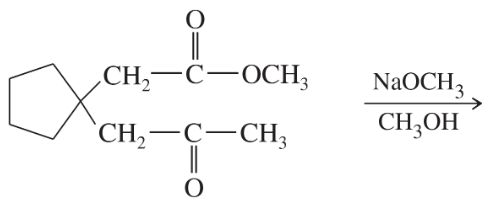
Predict the products of the following Claisen condensations.
(e)

Guida verificata passo dopo passo
1
Step 1: Identify the reaction type. This is a Claisen condensation, which involves the reaction of an ester with a base to form a β-keto ester or a β-diketone.
Step 2: Analyze the structure of the reactant. The molecule contains two ester groups: one with a methoxy group (-OCH3) and another with a methyl group (-CH3). The base used is sodium methoxide (NaOCH3), which will deprotonate the α-hydrogen (hydrogen adjacent to the carbonyl group) of the ester.
Step 3: Deprotonation occurs at the α-carbon of the ester group with the methoxy substituent. This generates an enolate ion, which is nucleophilic and can attack the carbonyl carbon of the other ester group.
Step 4: The enolate ion attacks the carbonyl carbon of the second ester group, leading to the formation of a new C-C bond. This results in the formation of a tetrahedral intermediate, which subsequently collapses to expel the methoxy group (-OCH3) as a leaving group.
Step 5: The final product is a β-diketone structure, where the two carbonyl groups are separated by a single carbon atom. This is the typical product of a Claisen condensation reaction.

Risposta video verificata per un problema simile:

Questa soluzione video è stata consigliata dai nostri tutor come utile per risolvere questo problema.
Durata del video:
6m

Concetti chiave

Ecco i concetti essenziali che devi comprendere per rispondere correttamente alla domanda.

Claisen Condensation

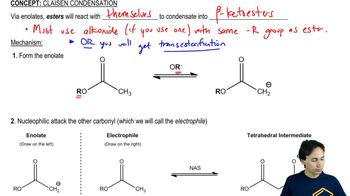
Claisen condensation is a reaction between two esters or an ester and a carbonyl compound in the presence of a strong base, typically an alkoxide. This reaction results in the formation of a β-keto ester or a β-diketone. The base deprotonates the alpha hydrogen of the ester, generating a nucleophile that attacks the carbonyl carbon of another ester, leading to the formation of a new carbon-carbon bond.
Video consigliato:
08:28
Claisen Condensation

Enolate Ion

An enolate ion is a resonance-stabilized anion formed when a hydrogen atom is removed from the alpha carbon of a carbonyl compound, such as an ester or ketone. This ion acts as a nucleophile in various organic reactions, including Claisen condensation. The stability of the enolate ion is crucial for the reaction's success, as it determines the reactivity and the products formed during the condensation.
Video consigliato:
02:26
Formation of Enolates

Reaction Conditions

The reaction conditions for Claisen condensation typically involve the use of a strong base, such as sodium ethoxide or sodium hydride, and a solvent like ethanol or methanol. These conditions facilitate the deprotonation of the ester and the subsequent nucleophilic attack on the carbonyl carbon. The choice of base and solvent can influence the reaction's efficiency and the stability of the intermediates formed during the process.
Video consigliato:
Percorso guidato
1:18
EAS Reactions of Pyridine Example 1