Ch. 22 - Condensations and Alpha Substitutions of Carbonyl Compounds
Wade - Organic Chemistry 9th Edition
Wade9th EditionOrganic ChemistryISBN: 9780135213728Non è quello che usi tu?Cambia libro di testo
Capitolo 22, Problema 82a

Propose a mechanism for the following reaction.
Chemical reaction diagram showing benzaldehyde and malonic ester reacting to form a compound undergoing hydrolysis and decarboxylation.

Guida verificata passo dopo passo
1
Identify the type of reaction taking place (e.g., substitution, elimination, addition, etc.) by analyzing the reactants and products. Look for functional group changes or bond rearrangements.
Determine the reactive sites in the molecule. For example, locate electrophilic and nucleophilic centers based on electron density, resonance, or inductive effects.
Propose the first step of the mechanism, which often involves the attack of a nucleophile on an electrophile or the departure of a leaving group. Use curved arrows to show the movement of electrons.
Continue the mechanism step-by-step, ensuring that each intermediate is reasonable and follows the principles of organic chemistry, such as charge stability, resonance, and steric effects.
Verify the proposed mechanism by ensuring that the final product matches the given product and that all steps are chemically plausible, adhering to the rules of electron flow and reaction conditions.

Risposta video verificata per un problema simile:

Questa soluzione video è stata consigliata dai nostri tutor come utile per risolvere questo problema.
Durata del video:
9m

Concetti chiave

Ecco i concetti essenziali che devi comprendere per rispondere correttamente alla domanda.

Reaction Mechanism

A reaction mechanism is a step-by-step description of how a chemical reaction occurs at the molecular level. It outlines the sequence of elementary steps, including bond breaking and formation, and the intermediates formed during the reaction. Understanding the mechanism helps predict the products and the conditions under which the reaction occurs.
Video consigliato:
02:16
Heck Reaction Mechanism

Nucleophiles and Electrophiles

Nucleophiles are species that donate an electron pair to form a chemical bond, while electrophiles are electron-deficient species that accept an electron pair. In many organic reactions, the interaction between nucleophiles and electrophiles is crucial, as it drives the formation of new bonds and the transformation of reactants into products.
Video consigliato:
03:
Nucleophile or Electrophile

Transition States and Intermediates

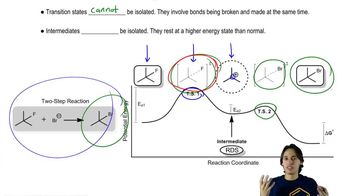
Transition states are high-energy states that occur during the transformation of reactants to products, representing the point of maximum energy along the reaction pathway. Intermediates are species that are formed and consumed during the reaction but are not present in the final products. Understanding these concepts is essential for proposing a detailed and accurate reaction mechanism.
Video consigliato:
06:55
Intermediates vs. Transition States
Pratica correlata
Domanda del libro di testo

Many of the condensations we have studied are reversible. The reverse reactions are often given the prefix retro-, the Latin word meaning “backward.” Propose mechanisms to account for the following reactions.

(b)

637
views

Domanda del libro di testo

Show the structure of the compound that results from hydrolysis and decarboxylation of the product.

987
views
Domanda del libro di testo

Show reaction sequences (not detailed mechanisms) that explain these transformations:

(a)

745
views
Domanda del libro di testo

Many of the condensations we have studied are reversible. The reverse reactions are often given the prefix retro-, the Latin word meaning “backward.” Propose mechanisms to account for the following reactions.

(c)

1134
views
Domanda del libro di testo

Biochemists studying the structure of collagen (a fibrous protein in connective tissue) found cross-links containing α,β-unsaturated aldehydes between protein chains. Show the structures of the side chains that react to form these cross-links, and propose a mechanism for their formation in a weakly acidic solution.

913
views
Domanda del libro di testo

(A true story.) Chemistry lab students added an excess of ethylmagnesium bromide to methyl furoate, expecting the Grignard reagent to add twice and form the tertiary alcohol. After water workup, they found that the product was a mixture of two compounds. One was the expected product having two ethyl groups, but the unexpected product had added three ethyl groups. Propose a mechanism to explain the formation of the unexpected product.

725
views