Ch. 22 - Condensations and Alpha Substitutions of Carbonyl Compounds
Wade - Organic Chemistry 9th Edition
Wade9th EditionOrganic ChemistryISBN: 9780135213728Non è quello che usi tu?Cambia libro di testo
Capitolo 22, Problema 11

Propose a mechanism to show how acetophenone undergoes base-promoted chlorination to give trichloroacetophenone.

Guida verificata passo dopo passo
1
Step 1: Identify the starting material (acetophenone) and the product (trichloroacetophenone). Acetophenone has a methyl group adjacent to the carbonyl group, which is susceptible to halogenation under basic conditions.
Step 2: Under basic conditions, the hydroxide ion (OH⁻) abstracts a proton from the methyl group of acetophenone, forming an enolate ion. The enolate ion is stabilized by resonance, with the negative charge delocalized onto the oxygen atom of the carbonyl group.
Step 3: The enolate ion reacts with chlorine (Cl₂), leading to the substitution of one hydrogen atom on the methyl group with a chlorine atom. This process repeats as the base continues to abstract protons from the methyl group, forming new enolate intermediates.
Step 4: Each subsequent enolate intermediate reacts with chlorine, replacing additional hydrogen atoms with chlorine atoms. This stepwise halogenation continues until all three hydrogens on the methyl group are replaced by chlorine atoms, forming the trichloromethyl group.
Step 5: The final product, trichloroacetophenone, is formed after the methyl group is fully chlorinated. The reaction stops at this stage because the trichloromethyl group is no longer acidic enough to form an enolate under the reaction conditions.

Risposta video verificata per un problema simile:

Questa soluzione video è stata consigliata dai nostri tutor come utile per risolvere questo problema.
Durata del video:
8m

Concetti chiave

Ecco i concetti essenziali che devi comprendere per rispondere correttamente alla domanda.

Acetophenone Structure and Reactivity

Acetophenone is an aromatic ketone with a phenyl group attached to a carbonyl (C=O) functional group. The presence of the carbonyl makes the molecule susceptible to nucleophilic attack, particularly at the alpha position. Understanding the structure helps in predicting how it will react under various conditions, including chlorination.
Video consigliato:
01:17
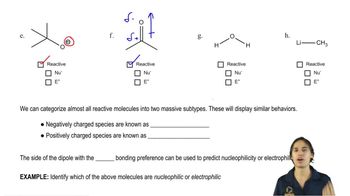
Reactivity of Molecules

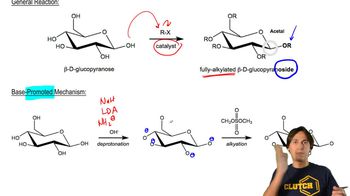
Base-Promoted Chlorination Mechanism

Base-promoted chlorination involves the deprotonation of the alpha hydrogen of acetophenone by a base, forming an enolate ion. This enolate ion acts as a nucleophile, attacking chlorine molecules (Cl2) to form chlorinated products. The mechanism typically proceeds through a series of steps, including the formation of the enolate, electrophilic attack, and subsequent protonation.
Video consigliato:
04:04
Base-Promoted Mechanism

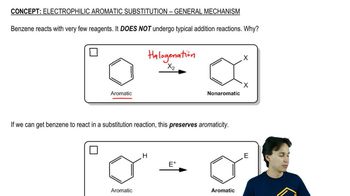
Electrophilic Aromatic Substitution

Electrophilic aromatic substitution (EAS) is a fundamental reaction in organic chemistry where an electrophile replaces a hydrogen atom on an aromatic ring. In the case of acetophenone, the chlorination occurs at the aromatic ring, facilitated by the electron-withdrawing nature of the carbonyl group, which enhances the reactivity of the ring towards electrophiles like chlorine.
Video consigliato:
03:07
EAS Review