Ch. 22 - Condensations and Alpha Substitutions of Carbonyl Compounds
Wade - Organic Chemistry 9th Edition
Wade9th EditionOrganic ChemistryISBN: 9780135213728Non è quello che usi tu?Cambia libro di testo
Capitolo 22, Problema 56d

Show how the following products might be synthesized from suitable Michael donors and acceptors.
(d)

Guida verificata passo dopo passo
1
Step 1: Identify the Michael reaction components. The Michael reaction involves a nucleophilic addition of a Michael donor (a compound with an active methylene group, such as a β-diketone or β-ketoester) to a Michael acceptor (an α,β-unsaturated carbonyl compound). For product (d), the Michael donor could be a β-ketoester or β-diketone, and the acceptor could be an α,β-unsaturated ketone or ester.
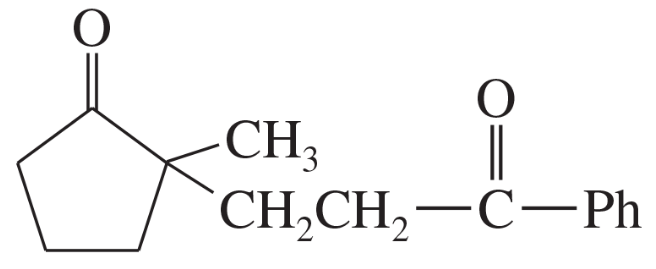
Step 2: Analyze the structure of product (d). The product contains a cyclopentanone ring with a methyl group and a phenyl-substituted ketone side chain. This suggests that the Michael donor must have contributed the cyclopentanone ring, while the Michael acceptor must have contributed the phenyl-substituted ketone group.
Step 3: Propose the Michael donor and acceptor for product (d). A suitable Michael donor could be 2-methylcyclopentanone, which has an active methylene group adjacent to the carbonyl. A suitable Michael acceptor could be phenyl vinyl ketone (Ph-CH=CH-CO). The reaction would involve the nucleophilic attack of the active methylene group on the β-carbon of the Michael acceptor.
Step 4: Analyze the structure of product (e). The product contains two ketone groups and a branched chain with a methyl group. This suggests that the Michael donor must have contributed the branched chain, while the Michael acceptor must have contributed the terminal ketone group.
Step 5: Propose the Michael donor and acceptor for product (e). A suitable Michael donor could be isobutyrylacetone (CH3-CO-CH2-CH(CH3)-CO-CH3), which has an active methylene group. A suitable Michael acceptor could be methyl vinyl ketone (CH2=CH-CO-CH3). The reaction would involve the nucleophilic attack of the active methylene group on the β-carbon of the Michael acceptor, followed by protonation to yield the final product.

Risposta video verificata per un problema simile:

Questa soluzione video è stata consigliata dai nostri tutor come utile per risolvere questo problema.
Durata del video:
2m

Concetti chiave

Ecco i concetti essenziali che devi comprendere per rispondere correttamente alla domanda.

Michael Addition

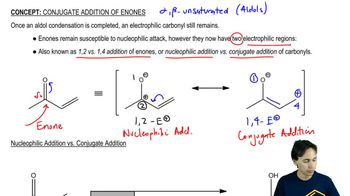
Michael addition is a nucleophilic addition reaction where a nucleophile adds to an α,β-unsaturated carbonyl compound. In this reaction, a Michael donor, typically a compound with a nucleophilic site, attacks the electrophilic β-carbon of the unsaturated carbonyl, forming a new carbon-carbon bond. This reaction is fundamental in organic synthesis for constructing complex molecules.
Video consigliato:
09:23
1,2 vs 1,4 Addition

Michael Donors and Acceptors

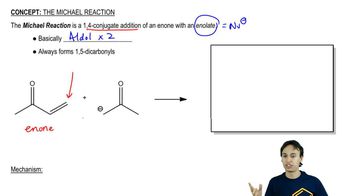
Michael donors are nucleophilic species that can donate electrons, such as enolates or other compounds with electron-rich sites. Michael acceptors, on the other hand, are typically α,β-unsaturated carbonyl compounds that can accept electrons due to the presence of a partial positive charge on the β-carbon. Understanding the nature of these donors and acceptors is crucial for predicting the outcome of Michael addition reactions.
Video consigliato:
02:34
General Reaction

Synthesis Strategies

Synthesis strategies in organic chemistry involve planning the steps required to construct a desired molecule from simpler starting materials. This includes selecting appropriate Michael donors and acceptors, determining reaction conditions, and considering the stereochemistry of the products. Effective synthesis requires a deep understanding of reaction mechanisms and the reactivity of various functional groups.
Video consigliato:
Percorso guidato
1:16
Synthesis of Amino Acids: Strecker Synthesis Example 1