Ch. 22 - Condensations and Alpha Substitutions of Carbonyl Compounds
Wade - Organic Chemistry 9th Edition
Wade9th EditionOrganic ChemistryISBN: 9780135213728Non è quello che usi tu?Cambia libro di testo
Capitolo 22, Problema 67c

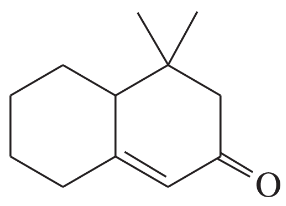
Show how you would use the Robinson annulation to synthesize the following compounds.
(c)

Guida verificata passo dopo passo
1
Identify the target compound and determine the key structural features that suggest it can be synthesized using the Robinson annulation. The Robinson annulation typically forms a six-membered ring through a Michael addition followed by an intramolecular aldol condensation.
Break down the target compound into two precursor molecules: (1) a Michael acceptor (α,β-unsaturated ketone) and (2) a Michael donor (a ketone or β-diketone). Analyze the structure of the target compound to identify these components.
Propose the Michael addition step. Write the reaction where the enolate ion of the Michael donor attacks the β-carbon of the Michael acceptor, forming a new carbon-carbon bond. Represent this step using MathML for clarity.
Describe the intramolecular aldol condensation step. After the Michael addition, the intermediate undergoes enolate formation at the α-carbon of the ketone, followed by nucleophilic attack on the carbonyl group within the same molecule. This forms a six-membered ring. Use MathML to show the mechanism.
Conclude by showing the dehydration step, where the aldol product loses a molecule of water to form the α,β-unsaturated ketone in the final product. Highlight the formation of the conjugated system in the target compound.

Risposta video verificata per un problema simile:

Questa soluzione video è stata consigliata dai nostri tutor come utile per risolvere questo problema.

Concetti chiave

Ecco i concetti essenziali che devi comprendere per rispondere correttamente alla domanda.

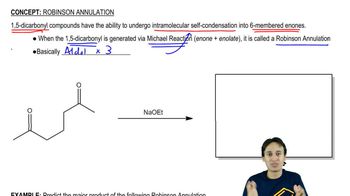
Robinson Annulation

The Robinson annulation is a key synthetic method in organic chemistry that combines a Michael addition and an intramolecular aldol reaction. This process allows for the formation of six-membered rings, which are common in many natural products. The reaction typically involves a β-keto ester and an α,β-unsaturated carbonyl compound, leading to the formation of a cyclohexenone structure.
Video consigliato:
04:12
Robinson Annulation

Michael Addition

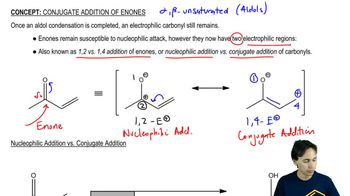
The Michael addition is a nucleophilic addition reaction where a nucleophile adds to an α,β-unsaturated carbonyl compound. This step is crucial in the Robinson annulation, as it forms a new carbon-carbon bond, setting the stage for subsequent reactions. The nucleophile can be a variety of species, including enolates, which are often generated from β-keto esters.
Video consigliato:
09:23
1,2 vs 1,4 Addition

Aldol Reaction

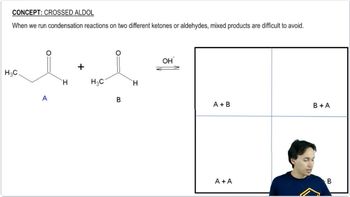
The aldol reaction involves the condensation of two aldehydes or ketones to form a β-hydroxy carbonyl compound. In the context of the Robinson annulation, the aldol reaction occurs after the Michael addition, where the intermediate formed undergoes dehydration to yield an α,β-unsaturated carbonyl compound. This step is essential for closing the ring and completing the synthesis of the desired cyclic structure.
Video consigliato:
09:51
Crossed Aldol