

Ch. 22 - Condensations and Alpha Substitutions of Carbonyl Compounds
Wade - Organic Chemistry 9th Edition
Wade9th EditionOrganic ChemistryISBN: 9780135213728Non è quello che usi tu?Cambia libro di testo
Capitolo 22, Problema 74b

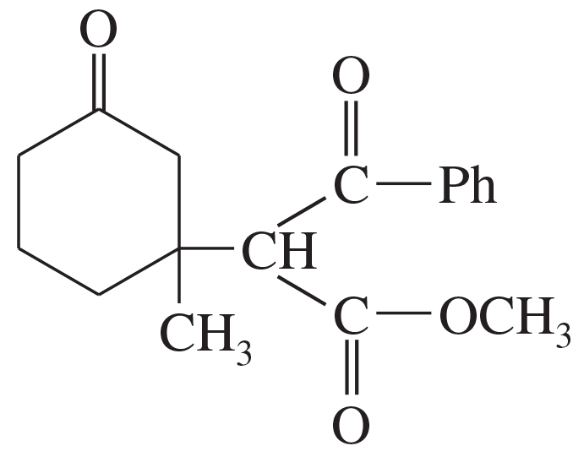
The following compounds can be synthesized by aldol condensations, followed by further reactions. (In each case, work backward from the target molecule to an aldol product, and show what compounds are needed for the condensation.)
(b)

Guida verificata passo dopo passo
1
Step 1: Analyze the target molecule. The given compound contains a β-hydroxy ketone structure, which is characteristic of an aldol condensation product. Additionally, it has a phenyl group (Ph) attached to one of the carbonyl carbons, indicating the involvement of an aromatic aldehyde in the reaction.
Step 2: Work backward to identify the aldol product. The target molecule suggests that the aldol condensation involved a cyclopentanone (as the ketone component) and benzaldehyde (as the aldehyde component). The β-hydroxy ketone intermediate would have formed before dehydration.
Step 3: Determine the starting materials. The aldol condensation requires an enolate ion formed from cyclopentanone and benzaldehyde as the electrophilic aldehyde. The enolate attacks the carbonyl carbon of benzaldehyde, forming the β-hydroxy ketone intermediate.
Step 4: Consider the dehydration step. After the aldol addition, the β-hydroxy ketone undergoes dehydration (loss of water) to form the α,β-unsaturated ketone. This step is typically acid- or base-catalyzed.
Step 5: Verify the synthesis pathway. The reaction sequence involves: (1) enolate formation from cyclopentanone, (2) nucleophilic attack on benzaldehyde, (3) formation of the β-hydroxy ketone intermediate, and (4) dehydration to yield the final product. Ensure the reaction conditions are appropriate for each step.

Risposta video verificata per un problema simile:

Questa soluzione video è stata consigliata dai nostri tutor come utile per risolvere questo problema.
Durata del video:
7m

Concetti chiave

Ecco i concetti essenziali che devi comprendere per rispondere correttamente alla domanda.

Aldol Condensation

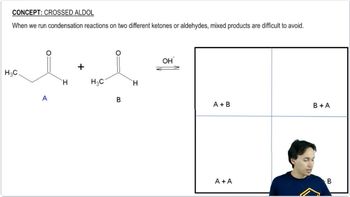
Aldol condensation is a fundamental reaction in organic chemistry where two aldehydes or ketones react in the presence of a base to form a β-hydroxy aldehyde or ketone, which can further dehydrate to yield an α,β-unsaturated carbonyl compound. This reaction is crucial for building complex molecules and is often used in synthetic pathways to create larger carbon frameworks.
Video consigliato:
09:51
Crossed Aldol

Retrosynthetic Analysis

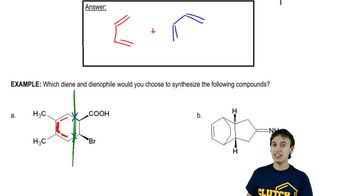
Retrosynthetic analysis is a problem-solving technique used in organic synthesis where the target molecule is deconstructed into simpler precursor structures. This approach helps chemists identify the necessary starting materials and reactions needed to synthesize a desired compound, facilitating the planning of synthetic routes in a logical manner.
Video consigliato:
01:22
Retrosynthesis

Functional Groups

Functional groups are specific groups of atoms within molecules that are responsible for the characteristic chemical reactions of those molecules. Understanding functional groups, such as carbonyls and phenyl groups in the provided compound, is essential for predicting reactivity and guiding the synthesis of organic compounds through various reactions, including aldol condensation.
Video consigliato:
02:36
Identifying Functional Groups