Ch. 22 - Condensations and Alpha Substitutions of Carbonyl Compounds
Wade - Organic Chemistry 9th Edition
Wade9th EditionOrganic ChemistryISBN: 9780135213728Non è quello che usi tu?Cambia libro di testo
Capitolo 22, Problema 75f

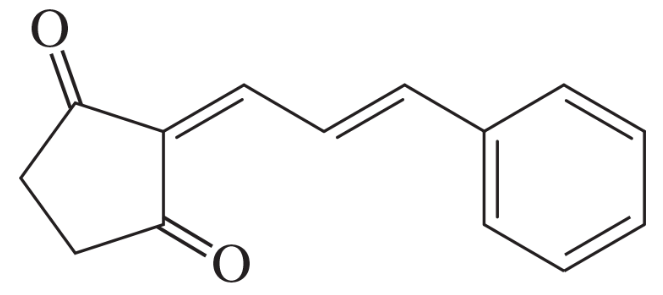
The Knoevenagel condensation is a special case of the aldol condensation in which an active methylene compound reacts with an aldehyde or ketone, in the presence of a secondary amine as a basic catalyst, to produce a new C=C. Show the starting materials that made each of these by a Knoevenagel condensation.
(f)

Guida verificata passo dopo passo
1
Step 1: Identify the product structure. The given compound contains a conjugated system with a C=C bond formed between a benzyl group and a cyclic ketone structure. This suggests it is the result of a Knoevenagel condensation reaction.
Step 2: Recall the general mechanism of Knoevenagel condensation. It involves the reaction of an active methylene compound (a compound with acidic hydrogens adjacent to a carbonyl group) with an aldehyde or ketone in the presence of a basic catalyst.
Step 3: Analyze the product to deduce the starting materials. The cyclic ketone structure in the product indicates that one starting material is likely a cyclic ketone, specifically cyclopentanone, as it matches the carbonyl group and ring structure.
Step 4: Examine the benzyl group attached to the C=C bond. This suggests the second starting material is benzaldehyde, as it provides the aromatic ring and the aldehyde functional group necessary for the reaction.
Step 5: Conclude the starting materials for the Knoevenagel condensation reaction that produced the given product are cyclopentanone and benzaldehyde. These react under basic conditions to form the conjugated product shown in the image.

Risposta video verificata per un problema simile:

Questa soluzione video è stata consigliata dai nostri tutor come utile per risolvere questo problema.
Durata del video:
1m

Concetti chiave

Ecco i concetti essenziali che devi comprendere per rispondere correttamente alla domanda.

Knoevenagel Condensation

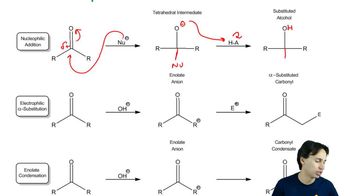
The Knoevenagel condensation is a reaction where an active methylene compound reacts with an aldehyde or ketone in the presence of a basic catalyst, typically a secondary amine. This reaction results in the formation of a carbon-carbon double bond (C=C) and is characterized by the elimination of a small molecule, often water. It is a key reaction in organic synthesis for forming α,β-unsaturated carbonyl compounds.
Video consigliato:
05:53
Condensation Reactions

Active Methylene Compounds

Active methylene compounds are organic molecules that contain a methylene group (–CH2–) adjacent to a carbonyl group (C=O) or other electron-withdrawing groups. This configuration makes the methylene hydrogen atoms particularly acidic, allowing them to be deprotonated to form a nucleophile that can participate in various reactions, including the Knoevenagel condensation. Common examples include malonic acid and acetylacetone.
Video consigliato:
01:40
Defining meso compounds.

Aldol Condensation

Aldol condensation is a fundamental reaction in organic chemistry where aldehydes or ketones with α-hydrogens undergo a reaction to form β-hydroxy aldehydes or ketones, which can further dehydrate to yield α,β-unsaturated carbonyl compounds. The Knoevenagel condensation can be viewed as a specific type of aldol condensation where the reaction involves an active methylene compound, highlighting the versatility of carbonyl chemistry in forming complex molecules.
Video consigliato:
09:51
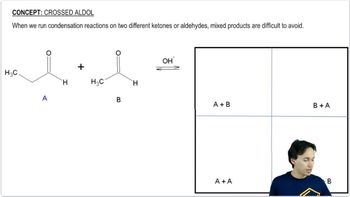
Crossed Aldol