Ch. 23 - Carbohydrates and Nucleic Acids
Wade - Organic Chemistry 9th Edition
Wade9th EditionOrganic ChemistryISBN: 9780135213728Non è quello che usi tu?Cambia libro di testo
Capitolo 23, Problema 45

All of the rings of the four heterocyclic bases are aromatic. This is more apparent when the polar resonance forms of the amide groups are drawn, as is done for thymine here. Redraw the hydrogen-bonded guanine-cytosine and adenine-thymine pairs shown in Figure 23-24, using the polar resonance forms of the amides. Show how these forms help to explain why the hydrogen bonds involved in these pairings are particularly strong. Remember that a hydrogen bond arises between an electron-deficient hydrogen atom and an electron-rich pair of nonbonding electrons.

Guida verificata passo dopo passo
1
Identify the polar resonance forms of the amide groups in the bases. For thymine, observe the resonance structure where the carbonyl oxygen carries a negative charge and the nitrogen carries a positive charge.
Redraw the guanine-cytosine and adenine-thymine base pairs, incorporating the polar resonance forms. This involves showing the resonance structures for each base where the amide groups are polarized.
For the guanine-cytosine pair, focus on the three hydrogen bonds that form between the bases. Highlight how the resonance forms increase the electron density on the oxygen and nitrogen atoms, making them more effective hydrogen bond acceptors.
For the adenine-thymine pair, illustrate the two hydrogen bonds. Emphasize how the resonance forms enhance the electron-deficient nature of the hydrogen atoms involved in hydrogen bonding, making them stronger hydrogen bond donors.
Explain that the increased polarity in the resonance forms leads to stronger hydrogen bonds because the electron-rich and electron-deficient sites are more pronounced, facilitating stronger interactions between the bases.

Risposta video verificata per un problema simile:

Questa soluzione video è stata consigliata dai nostri tutor come utile per risolvere questo problema.
Durata del video:
16m

Concetti chiave

Ecco i concetti essenziali che devi comprendere per rispondere correttamente alla domanda.

Aromaticity

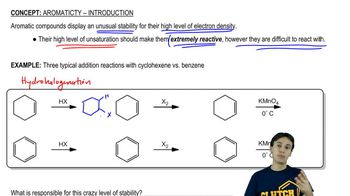
Aromaticity refers to the property of cyclic compounds that exhibit enhanced stability due to the delocalization of π electrons across the ring structure. This occurs when the compound follows Hückel's rule, which states that a molecule must have a planar structure and contain a specific number of π electrons (4n + 2, where n is a non-negative integer). In the context of heterocyclic bases, aromaticity contributes to their stability and reactivity.
Video consigliato:
08:19
Intro to Aromaticity

Hydrogen Bonding

Hydrogen bonding is a type of attractive interaction that occurs between a hydrogen atom covalently bonded to an electronegative atom and another electronegative atom with a lone pair of electrons. In nucleic acids, hydrogen bonds play a crucial role in stabilizing the double helix structure by forming specific pairs between bases, such as guanine-cytosine and adenine-thymine. The strength of these bonds is influenced by the polarity of the involved atoms and the resonance forms of the bases.
Video consigliato:
00:48
The definition of hydrogenation.

Resonance Structures

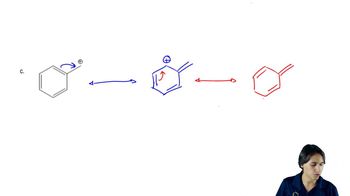
Resonance structures are different ways of drawing a molecule that represent the same arrangement of atoms but differ in the distribution of electrons. These structures help illustrate the delocalization of electrons within a molecule, which can affect its reactivity and stability. In the case of the amide groups in nucleobases, drawing resonance forms can clarify how electron density is distributed, thereby influencing the strength of hydrogen bonds formed between base pairs.
Video consigliato:
03:04
Drawing Resonance Structures