Ch. 24 - Amino Acids, Peptides, and Proteins
Wade - Organic Chemistry 9th Edition
Wade9th EditionOrganic ChemistryISBN: 9780135213728Non è quello che usi tu?Cambia libro di testo
Capitolo 24, Problema 16

Give equations for the formation and hydrogenolysis of N-benzyloxycarbonyl methionine.

Guida verificata passo dopo passo
1
Identify the structure of N-benzyloxycarbonyl methionine. This compound is a derivative of methionine where the amino group (-NH2) is protected by a benzyloxycarbonyl (Cbz) group. The general structure of the Cbz group is C6H5CH2OCO-.
Write the reaction for the formation of N-benzyloxycarbonyl methionine. This typically involves reacting methionine with benzyl chloroformate (C6H5CH2OCOCl) in the presence of a base (e.g., NaOH or NaHCO3) to neutralize the HCl byproduct. The reaction can be represented as: \( \text{H2N-CH(CH2CH2SCH3)-COOH} + \text{C6H5CH2OCOCl} \rightarrow \text{C6H5CH2OCO-NH-CH(CH2CH2SCH3)-COOH} + \text{HCl} \).
Explain the purpose of the benzyloxycarbonyl (Cbz) group. It is a protecting group used to temporarily block the amino group (-NH2) during chemical reactions to prevent unwanted side reactions. This is particularly useful in peptide synthesis.
Write the reaction for the hydrogenolysis of N-benzyloxycarbonyl methionine. Hydrogenolysis involves the removal of the Cbz group using hydrogen gas (H2) in the presence of a palladium catalyst (e.g., Pd/C). The reaction can be represented as: \( \text{C6H5CH2OCO-NH-CH(CH2CH2SCH3)-COOH} + \text{H2} \xrightarrow{\text{Pd/C}} \text{H2N-CH(CH2CH2SCH3)-COOH} + \text{C6H5CH3} + \text{CO2} \).
Summarize the overall process. The formation of N-benzyloxycarbonyl methionine involves protecting the amino group of methionine with a Cbz group using benzyl chloroformate. The hydrogenolysis step removes the Cbz group, regenerating the free amino group and producing toluene (C6H5CH3) and carbon dioxide (CO2) as byproducts.

Risposta video verificata per un problema simile:

Questa soluzione video è stata consigliata dai nostri tutor come utile per risolvere questo problema.
Durata del video:
3m

Concetti chiave

Ecco i concetti essenziali che devi comprendere per rispondere correttamente alla domanda.

N-benzyloxycarbonyl (Z) Group

The N-benzyloxycarbonyl (Z) group is a protective group used in organic synthesis, particularly in peptide chemistry. It protects the amine group of amino acids during reactions, preventing unwanted side reactions. The Z group can be removed under specific conditions, allowing for the subsequent functionalization of the amino acid.
Video consigliato:
03:48
E/Z Diastereoisomerism

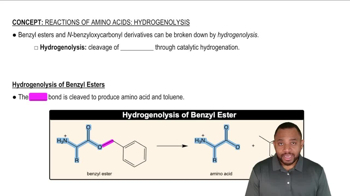
Hydrogenolysis

Hydrogenolysis is a chemical reaction that involves the cleavage of a bond by hydrogen in the presence of a catalyst, typically resulting in the removal of a protecting group. In the context of N-benzyloxycarbonyl methionine, hydrogenolysis would involve the reduction of the Z group to yield the free amino acid. This reaction is crucial for the synthesis of peptides and proteins.
Video consigliato:
Percorso guidato
2:01
Reactions of Amino Acids: Hydrogenolysis Concept 1

Formation of N-benzyloxycarbonyl Methionine

The formation of N-benzyloxycarbonyl methionine involves the reaction of methionine with benzyloxycarbonyl chloride (Z-Cl) in the presence of a base. This reaction results in the attachment of the Z group to the amino group of methionine, creating a protected amino acid that can be used in peptide synthesis without interference from the amine.
Video consigliato:
Percorso guidato
3:06
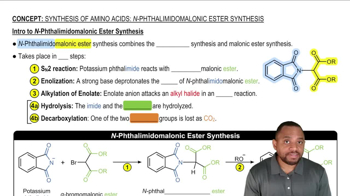
Synthesis of Amino Acids: N-Phthalimidomalonic Ester Synthesis Concept 1