Ch.4 - The Study of Chemical Reactions
Wade - Organic Chemistry 9th Edition
Wade9th EditionOrganic ChemistryISBN: 9780135213728Non è quello che usi tu?Cambia libro di testo
Capitolo 4, Problema 14a

Draw the reaction-energy diagram for the following reverse reaction:
•CH3 + HCl → CH4 + Cl•

Guida verificata passo dopo passo
1
Step 1: Understand the reverse reaction. The reverse reaction involves the formation of a methyl radical (•CH3) and hydrogen chloride (HCl) from methane (CH4) and a chlorine radical (Cl•). This is the reverse of a typical radical halogenation reaction.
Step 2: Identify the energy components of the reaction. The reaction-energy diagram will include the reactants (CH4 and Cl•), the transition state, and the products (•CH3 and HCl). The energy of the transition state will be higher than both the reactants and products.
Step 3: Determine the relative energy levels. Methane (CH4) is a stable molecule, so it will have a lower energy compared to the methyl radical (•CH3). The chlorine radical (Cl•) is also relatively reactive, so its energy will be higher than CH4 but lower than the transition state.
Step 4: Sketch the reaction-energy diagram. On the y-axis, plot the energy levels, and on the x-axis, plot the reaction progress. Start with CH4 and Cl• as the reactants, show a peak for the transition state, and end with •CH3 and HCl as the products. Label each part of the diagram clearly.
Step 5: Indicate the activation energy and overall energy change. The activation energy is the difference between the energy of the reactants and the transition state. The overall energy change (ΔE) is the difference between the energy of the reactants and the products. Ensure these are marked on the diagram.

Risposta video verificata per un problema simile:

Questa soluzione video è stata consigliata dai nostri tutor come utile per risolvere questo problema.
Durata del video:
4m

Concetti chiave

Ecco i concetti essenziali che devi comprendere per rispondere correttamente alla domanda.

Reaction Energy Diagram

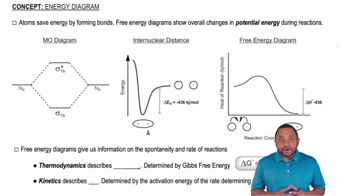
A reaction energy diagram visually represents the energy changes during a chemical reaction. It typically includes the energy of reactants and products, as well as the activation energy required for the reaction to proceed. The diagram helps illustrate the transition state and the overall energy change, indicating whether the reaction is exothermic or endothermic.
Video consigliato:
08:30
Introduction to free energy diagrams.

Activation Energy

Activation energy is the minimum energy required for a chemical reaction to occur. It represents the energy barrier that reactants must overcome to form products. In a reaction energy diagram, this is depicted as the peak of the curve, where the transition state exists before the system can proceed to the products.
Video consigliato:
08:30
Introduction to free energy diagrams.

Bond Dissociation Energy

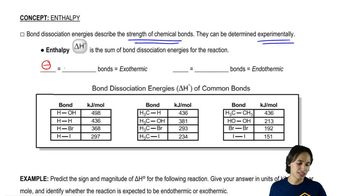
Bond dissociation energy is the energy required to break a specific bond in a molecule. In the context of the given reaction, understanding the bond dissociation energies of H-Cl and C-H bonds is crucial for predicting the energy changes during the reaction. This concept helps explain the stability of reactants and products and their relative energies in the reaction energy diagram.
Video consigliato:
04:09
How to calculate enthalpy using bond dissociation energies.
Pratica correlata
Domanda del libro di testo

Under certain conditions, the bromination of cyclohexene follows an unusual rate law:

c. What is the overall kinetic order?

948
views

Domanda del libro di testo

When a small piece of platinum is added to a mixture of ethene and hydrogen, the ­following reaction occurs: Ethene

Doubling the concentration of hydrogen has no effect on the reaction rate. Doubling the concentration of ethene also has no effect.

a. What is the kinetic order of this reaction with respect to ethene? With respect to hydrogen? What is the overall order?

1825
views
Domanda del libro di testo

When a small piece of platinum is added to a mixture of ethene and hydrogen, the ­following reaction occurs:

Doubling the concentration of hydrogen has no effect on the reaction rate. Doubling the concentration of ethene also has no effect.

b. Write the unusual rate equation for this reaction.

c. Explain this strange rate equation, and suggest what one might do to accelerate the reaction.

801
views
Domanda del libro di testo

•CH3 + HCl → CH4 + Cl•

b. What is the activation energy for this reverse reaction?

c. What is the heat of reaction (ΔH°) for this reverse reaction?

1467
views
Domanda del libro di testo

Draw a reaction-energy diagram for the following reaction:

•CH3 + Cl2 → CH3Cl + Cl•

The activation energy is 4 kJ/mol (1 kcal/mol), and the overall ΔH° for the reaction is –110 kJ/mol (–27 kcal/mol).

1285
views
Domanda del libro di testo

•CH3 + Cl2 → CH3Cl + Cl•

The activation energy is 4 kJ/mol (1 kcal/mol), and the overall ΔH° for the reaction is –110 kJ/mol (–27 kcal/mol).

b. Give the equation for the reverse reaction.

c. What is the activation energy for the reverse reaction?

1971
views