Ch.4 - The Study of Chemical Reactions
Wade - Organic Chemistry 9th Edition
Wade9th EditionOrganic ChemistryISBN: 9780135213728Non è quello che usi tu?Cambia libro di testo
Capitolo 4, Problema 9c,d

b. Calculate ΔH° for each step in this reaction.
c. Calculate the overall value of ΔH° for this reaction.

Guida verificata passo dopo passo
1
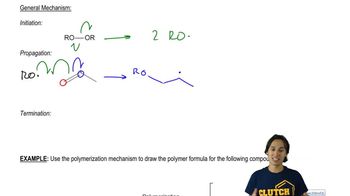
Step 1: Understand the reaction mechanism. Free-radical chlorination involves three main steps: initiation, propagation, and termination. In the initiation step, the chlorine molecule (Cl₂) absorbs energy from light (hv) and undergoes homolytic cleavage to form two chlorine radicals (Cl•).
Step 2: Write the propagation steps. In the first propagation step, a chlorine radical (Cl•) reacts with ethane (CH₃—CH₃) to abstract a hydrogen atom, forming a methyl radical (CH₃—CH₂•) and HCl. In the second propagation step, the methyl radical reacts with another chlorine molecule (Cl₂) to form the product (CH₃—CH₂Cl) and regenerate a chlorine radical (Cl•).
Step 3: Analyze the termination steps. Termination occurs when two radicals combine to form a stable molecule, such as Cl• + Cl• → Cl₂ or CH₃—CH₂• + Cl• → CH₃—CH₂Cl. These steps reduce the number of free radicals in the system.
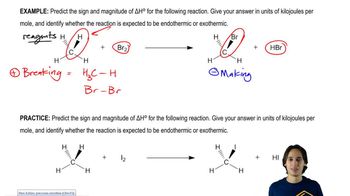
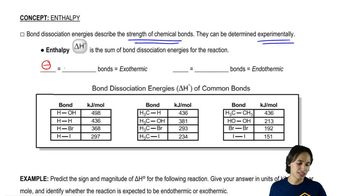
Step 4: To calculate ΔH° for each step, use bond dissociation energies (BDEs). For example, calculate the energy change for breaking the Cl—Cl bond in the initiation step, the energy change for breaking the C—H bond in ethane during propagation, and the energy change for forming new bonds (C—Cl and H—Cl). Use the formula ΔH° = Σ(BDE bonds broken) - Σ(BDE bonds formed).
Step 5: Calculate the overall ΔH° for the reaction by summing the ΔH° values for all steps. This will give the net energy change for the reaction. Ensure that all bond dissociation energy values are correctly referenced from a reliable source, such as a chemistry textbook or database.

Risposta video verificata per un problema simile:

Questa soluzione video è stata consigliata dai nostri tutor come utile per risolvere questo problema.
Durata del video:
7m

Concetti chiave

Ecco i concetti essenziali che devi comprendere per rispondere correttamente alla domanda.

Free-Radical Mechanism

The free-radical mechanism involves a series of steps where free radicals are generated and react with other molecules. In the chlorination of ethane, the process typically includes initiation (formation of radicals), propagation (reaction of radicals with ethane), and termination (recombination of radicals). Understanding this mechanism is crucial for proposing a detailed reaction pathway.
Video consigliato:
03:28
The mechanism of Radical Polymerization.

Enthalpy Change (ΔH°)

Enthalpy change (ΔH°) is a measure of the heat absorbed or released during a chemical reaction at constant pressure. It is essential for calculating the energy changes associated with each step of the reaction mechanism. By determining the ΔH° for individual steps, one can assess the overall energy profile of the reaction.
Video consigliato:
04:38
Calculating Enthalpies

Bond Dissociation Energy

Bond dissociation energy refers to the energy required to break a specific bond in a molecule, resulting in the formation of free radicals. This concept is vital for calculating ΔH° in the chlorination reaction, as it allows for the quantification of energy changes when bonds are broken and formed during the reaction steps.
Video consigliato:
04:09
How to calculate enthalpy using bond dissociation energies.