Ch.4 - The Study of Chemical Reactions
Wade - Organic Chemistry 9th Edition
Wade9th EditionOrganic ChemistryISBN: 9780135213728Non è quello che usi tu?Cambia libro di testo
Capitolo 4, Problema 9a

a. Propose a mechanism for the free-radical chlorination of ethane,

Guida verificata passo dopo passo
1
Step 1: Initiation - The process begins with the homolytic cleavage of the Cl-Cl bond under the influence of UV light (hv). This generates two chlorine radicals (Cl•). The reaction can be represented as: Cl2→Cl•+Cl•
Step 2: Propagation - In the first propagation step, a chlorine radical abstracts a hydrogen atom from ethane (CH3—CH3), forming a methyl radical (CH3—CH2•) and HCl. The reaction can be represented as: Cl•+CH3—CH3→CH3—CH2•+HCl
Step 3: Propagation - In the second propagation step, the methyl radical reacts with another Cl2 molecule, forming the chlorinated product (CH3—CH2Cl) and regenerating a chlorine radical. The reaction can be represented as: CH3—CH2•+Cl2→CH3—CH2Cl+Cl•
Step 4: Termination - The reaction can terminate when two radicals combine to form a stable molecule. For example, two chlorine radicals can combine to regenerate Cl2, or a methyl radical can combine with a chlorine radical to form CH3—CH2Cl. These termination steps reduce the number of radicals in the system.
Step 5: Summary - The overall reaction involves the conversion of ethane (CH3—CH3) and chlorine (Cl2) into chloroethane (CH3—CH2Cl) and HCl, with the mechanism proceeding through initiation, propagation, and termination steps. The free-radical mechanism is driven by the generation and interaction of reactive radical species.

Risposta video verificata per un problema simile:

Questa soluzione video è stata consigliata dai nostri tutor come utile per risolvere questo problema.
Durata del video:
8m

Concetti chiave

Ecco i concetti essenziali che devi comprendere per rispondere correttamente alla domanda.

Free Radical Mechanism

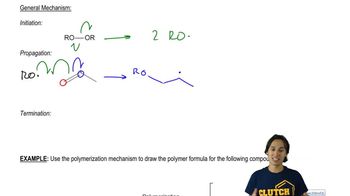
The free radical mechanism involves a series of steps where free radicals are generated and react with other molecules. In the case of chlorination, the process typically includes initiation, propagation, and termination steps. Initiation generates free radicals from chlorine molecules, propagation involves the reaction of these radicals with ethane to form chlorinated products, and termination occurs when two radicals combine to form a stable molecule.
Video consigliato:
03:28
The mechanism of Radical Polymerization.

Chlorination of Alkanes

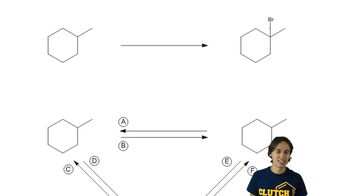
Chlorination of alkanes is a substitution reaction where hydrogen atoms in an alkane are replaced by chlorine atoms. This reaction is facilitated by the presence of light (hv) or heat, which provides the energy needed to break the Cl-Cl bond, generating chlorine radicals. The resulting chlorinated products can vary based on the number of hydrogen atoms replaced and the reaction conditions.
Video consigliato:
02:47
Functionalizing Alkanes

Selectivity in Radical Reactions

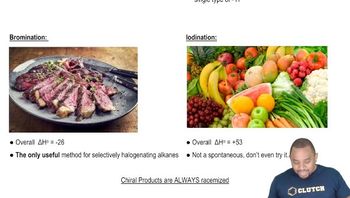
Selectivity in radical reactions refers to the preference of radicals to abstract certain hydrogen atoms over others, leading to different products. In the case of ethane, the formation of primary versus secondary radicals can influence the distribution of chlorinated products. The stability of the resulting radical intermediates plays a crucial role in determining which hydrogen atoms are more likely to be replaced during the chlorination process.
Video consigliato:
10:08
Radical selectivity: Food Analogy