


Ch.4 - The Study of Chemical Reactions
Wade - Organic Chemistry 9th Edition
Wade9th EditionOrganic ChemistryISBN: 9780135213728Non è quello che usi tu?Cambia libro di testo
Capitolo 4, Problema 45b

Draw the important resonance forms of the following free radicals.
b.

Guida verificata passo dopo passo
1
Identify the free radical in the given structure. In this case, the free radical is located on the CH2 group attached to the benzene ring.
Recognize that the benzene ring can participate in resonance with the free radical. The unpaired electron on the CH2 group can interact with the π-electrons of the benzene ring.
Draw the first resonance form by moving the unpaired electron from the CH2 group to form a double bond with the adjacent carbon of the benzene ring. This will result in the movement of the π-electrons in the benzene ring.
Continue the resonance by moving the π-electrons around the benzene ring. This will create a new resonance form where the unpaired electron is now located on a different carbon atom in the benzene ring.
Repeat the process to generate additional resonance forms, ensuring that the unpaired electron is delocalized around the benzene ring, which stabilizes the free radical through resonance.

Risposta video verificata per un problema simile:

Questa soluzione video è stata consigliata dai nostri tutor come utile per risolvere questo problema.
Durata del video:
5m

Concetti chiave

Ecco i concetti essenziali che devi comprendere per rispondere correttamente alla domanda.

Resonance Structures

Resonance structures are different ways of drawing the same molecule that illustrate the delocalization of electrons. In the case of free radicals, resonance can help distribute the unpaired electron across multiple atoms, stabilizing the radical. Understanding how to draw these structures is crucial for predicting the reactivity and stability of the molecule.
Video consigliato:
03:04
Drawing Resonance Structures

Free Radicals

Free radicals are species that contain an unpaired electron, making them highly reactive. They can be formed through various processes, including the homolytic cleavage of covalent bonds. In organic chemistry, understanding the behavior of free radicals is essential for predicting reaction mechanisms and outcomes, especially in radical substitution reactions.
Video consigliato:
03:28
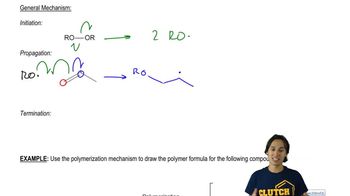
The mechanism of Radical Polymerization.

Aromatic Stability

Aromatic compounds, like benzene, exhibit unique stability due to their cyclic structure and delocalized π electrons. This stability influences the behavior of substituents, including free radicals, on the aromatic ring. Recognizing how resonance and aromaticity contribute to the stability of radicals is key to understanding their reactivity in organic reactions.
Video consigliato:
08:19
Intro to Aromaticity