
Ch.4 - The Study of Chemical Reactions
Wade - Organic Chemistry 9th Edition
Wade9th EditionOrganic ChemistryISBN: 9780135213728Non è quello che usi tu?Cambia libro di testo
Capitolo 4, Problema 58

Iodination of alkanes using iodine (I2) is usually an unfavorable reaction. (See Problem 4-17 , for example.) Tetraiodomethane (CI4) can be used as the iodine source for iodination in the presence of a free-radical initiator such as hydrogen peroxide. Propose a mechanism (involving mildly exothermic propagation steps) for the following proposed reaction. Calculate the value of ΔH for each of the steps in your proposed mechanism.

The following bond-dissociation energies maybe helpful:

Guida verificata passo dopo passo
1
Step 1: Initiation - The reaction begins with the homolytic cleavage of the O-O bond in hydrogen peroxide (H₂O₂) under heat. This generates two hydroxyl radicals (•OH). The bond dissociation energy for HO-OH is 213 kJ/mol.
Step 2: Radical generation - One hydroxyl radical reacts with tetraiodomethane (CI₄), breaking the I₃C-I bond homolytically to form a triiodomethyl radical (•I₃C) and HO-I. The bond dissociation energy for I₃C-I is 188 kJ/mol, and for HO-I is 234 kJ/mol.
Step 3: Propagation - The triiodomethyl radical (•I₃C) abstracts a hydrogen atom from cyclopentane, forming cyclopentyl radical (•C₅H₉) and I₃C-H. The bond dissociation energy for I₃C-H is 418 kJ/mol, and for C₅H₉-H is 413 kJ/mol.
Step 4: Radical substitution - The cyclopentyl radical (•C₅H₉) reacts with another molecule of tetraiodomethane (CI₄), breaking the I₃C-I bond homolytically to form cyclopentyl iodide (C₅H₉-I) and regenerating the triiodomethyl radical (•I₃C). The bond dissociation energy for C₅H₉-I is 238 kJ/mol.
Step 5: Termination - The reaction terminates when two radicals combine, such as two triiodomethyl radicals (•I₃C) forming hexaiodoethane (I₆C₂), or other radical combinations. This step stabilizes the system and ends the chain reaction.

Risposta video verificata per un problema simile:

Questa soluzione video è stata consigliata dai nostri tutor come utile per risolvere questo problema.
Durata del video:
12m

Concetti chiave

Ecco i concetti essenziali che devi comprendere per rispondere correttamente alla domanda.

Free Radical Mechanism

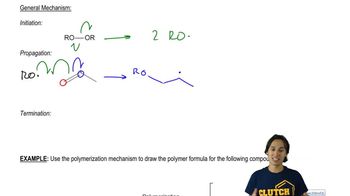
The iodination of alkanes via iodine (I2) involves a free radical mechanism, which consists of initiation, propagation, and termination steps. In this context, hydrogen peroxide acts as a radical initiator, generating iodine radicals that can abstract hydrogen from the alkane, forming alkyl radicals. These alkyl radicals can then react with iodine to produce iodinated products, illustrating the chain reaction characteristic of free radical processes.
Video consigliato:
03:28
The mechanism of Radical Polymerization.

Bond Dissociation Energy (BDE)

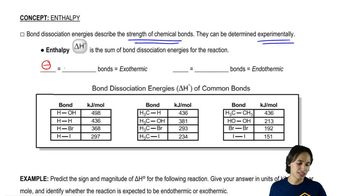
Bond dissociation energy is the energy required to break a specific bond in a molecule, resulting in the formation of free radicals. In the context of the proposed reaction, knowing the BDEs of C-I and C-H bonds is crucial for calculating the enthalpy changes (ΔH) for each step of the mechanism. This information helps predict the feasibility of the reaction and the energy changes associated with bond formation and cleavage.
Video consigliato:
04:09
How to calculate enthalpy using bond dissociation energies.

Enthalpy Change (ΔH)

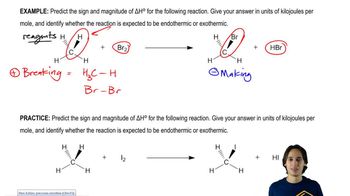
Enthalpy change (ΔH) is a measure of the heat absorbed or released during a chemical reaction at constant pressure. In this reaction, calculating ΔH for each step of the proposed mechanism allows for an understanding of the overall energy profile of the reaction. Mildly exothermic propagation steps indicate that the reaction is energetically favorable, which is essential for assessing the viability of iodination using tetraiodomethane as the iodine source.
Video consigliato:
04:38
Calculating Enthalpies
Pratica correlata
Domanda del libro di testo

Deuterium (D) is the hydrogen isotope of mass number 2, with a proton and a neutron in its nucleus. The chemistry of deuterium is nearly identical to the chemistry of hydrogen, except that the C―D bond is slightly stronger than the C―H bond by 5.0 kJ/mol (1.2 kcal/ mol). Reaction rates tend to be slower when a C―D bond (as opposed to a C―H bond) is broken in a rate-limiting step.

This effect, called a kinetic isotope effect, is clearly seen in the chlorination of methane. Methane undergoes free-radical chlorination 12 times as fast as tetradeuteriomethane (CD4).

c. Consider the thermodynamics of the chlorination of methane and the chlorination of ethane, and use the Hammond postulate to explain why one of these reactions has a much larger isotope effect than the other.

1369
views
Domanda del libro di testo

Deuterium (D) is the hydrogen isotope of mass number 2, with a proton and a neutron in its nucleus. The chemistry of deuterium is nearly identical to the chemistry of hydrogen, except that the C―D bond is slightly stronger than the C―H bond by 5.0 kJ/mol (1.2 kcal/mol). Reaction rates tend to be slower when a C―D bond (as opposed to a C―H bond) is broken in a rate-limiting step.

This effect, called a kinetic isotope effect, is clearly seen in the chlorination of methane. Methane undergoes free-radical chlorination 12 times as fast as tetradeuteriomethane (CD4).

a. Draw the transition state for the rate-limiting step of each of these reactions, showing how a bond to hydrogen or ­deuterium is being broken in this step.

835
views
Domanda del libro di testo

Deuterium (D) is the hydrogen isotope of mass number 2, with a proton and a neutron in its nucleus. The chemistry of deuterium is nearly identical to the chemistry of hydrogen, except that the C―D bond is slightly stronger than the C―H bond by 5.0 kJ/mol (1.2 kcal/mol). Reaction rates tend to be slower when a C―D bond (as opposed to a C―H bond) is broken in a rate-limiting step.

This effect, called a kinetic isotope effect, is clearly seen in the chlorination of methane. Methane undergoes free-radical chlorination 12 times as fast as tetradeuteriomethane (CD4).

b. Monochlorination of deuterioethane (C2H5D) leads to a mixture containing 93% C2H4DCl and 7% C2H5Cl. Calculate the relative rates of abstraction per hydrogen and deuterium in the chlorination of deuterioethane.

734
views