Ch.4 - The Study of Chemical Reactions
Wade - Organic Chemistry 9th Edition
Wade9th EditionOrganic ChemistryISBN: 9780135213728Non è quello che usi tu?Cambia libro di testo
Capitolo 4, Problema 4

The reaction of tert-butyl chloride with methanol (CH3)3C—Cl Tert-butylchloride + CH3—OH methanol —> (CH3)C—OCH3 methyltert-butylether + HCl is found to follow the rate equation rate= Kt[(CH3)3C—Cl] a. What is the kinetic order with respect to tert-butyl chloride?

Guida verificata passo dopo passo
1
Identify the given rate equation: \( \text{rate} = k_t[(\text{CH}_3)_3\text{C—Cl}] \).
Recognize that the rate equation shows the dependence of the reaction rate on the concentration of tert-butyl chloride.
Notice that the rate equation only includes the concentration of tert-butyl chloride, \((\text{CH}_3)_3\text{C—Cl}\), and no other reactants.
Determine the kinetic order with respect to tert-butyl chloride by examining the exponent of its concentration in the rate equation.
Conclude that the kinetic order with respect to tert-butyl chloride is the exponent of its concentration in the rate equation, which is 1.

Risposta video verificata per un problema simile:

Questa soluzione video è stata consigliata dai nostri tutor come utile per risolvere questo problema.
Durata del video:
1m

Concetti chiave

Ecco i concetti essenziali che devi comprendere per rispondere correttamente alla domanda.

Kinetics and Rate Laws

Kinetics is the study of the rates of chemical reactions. A rate law expresses the relationship between the rate of a reaction and the concentration of its reactants. The rate equation provided indicates that the rate of the reaction depends only on the concentration of tert-butyl chloride, which is crucial for determining the reaction's order.
Video consigliato:
Percorso guidato
5:07
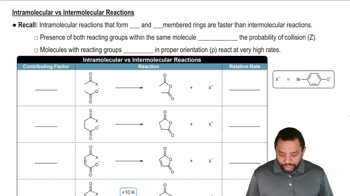
Rates of Intramolecular Reactions Concept 2

Reaction Order

The reaction order is the exponent to which the concentration of a reactant is raised in the rate law. It indicates how the rate of reaction changes with varying concentrations of reactants. In this case, since the rate equation is first-order with respect to tert-butyl chloride, it means that doubling the concentration of tert-butyl chloride will double the reaction rate.
Video consigliato:
01:42
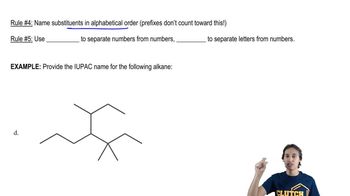
Proper name ordering and punctuation

Unimolecular Reactions

Unimolecular reactions involve a single reactant molecule undergoing a transformation, often leading to a product without the need for a second reactant. The reaction of tert-butyl chloride with methanol is likely unimolecular, as indicated by the first-order rate law, suggesting that the rate is determined solely by the concentration of tert-butyl chloride.
Video consigliato:
05:09
Heck Reaction
Pratica correlata
Domanda del libro di testo

Each of the following proposed mechanisms for the free-radical chlorination of methane is wrong. Explain how the experimental evidence disproves each mechanism.

b.

695
views

Domanda del libro di testo
Deuterium (D) is the hydrogen isotope of mass number 2, with a proton and a neutron in its nucleus. The chemistry of deuterium is nearly identical to the chemistry of hydrogen, except that the C―D bond is slightly stronger than the C―H bond by 5.0 kJ/mol (1.2 kcal/ mol). Reaction rates tend to be slower when a C―D bond (as opposed to a C―H bond) is broken in a rate-limiting step. This effect, called a kinetic isotope effect, is clearly seen in the chlorination of methane. Methane undergoes free-radical chlorination 12 times as fast as tetradeuteriomethane (CD4) Faster: CH4 + Cl⋅ —> CH3Cl + HCl relative rate= 12 Slower: CD4 + Cl⋅ —> CD3Cl + DCl relative rate= 1 c. Consider the thermodynamics of the chlorination of methane and the chlorination of ethane, and use the Hammond postulate to explain why one of these reactions has a much larger isotope effect than the other.
1786
views
Domanda del libro di testo
Use bond-dissociation enthalpies [TABLE 4-2], p. 167) to calculate values of ΔH° for the following reactions. a. CH3—CH3 + I2 —> CH3CH2I + HI
1425
views
Domanda del libro di testo
The bromination of methane proceeds through the following steps: 1. Br2 + 2 Br• ΔH° (per mole)/+190 kJ (45 kcal) Ea (per mole)/ 190 kJ (45 kcal) 2. CH4 + Br• —> CH3+ HBr +73 kJ (17 kcal) 79 kJ (19 kcal) 3. • CH3 + Br2 —> CH3Br + Br -112 kJ (-27 kcal) 4 kJ (1 kcal) d. Compute the overall value of ΔH° for the bromination
1172
views
Domanda del libro di testo

Each of the following proposed mechanisms for the free-radical chlorination of methane is wrong. Explain how the experimental evidence disproves each mechanism.

a.

1215
views
Domanda del libro di testo

How could an industrial plant control the proportions of methane and chlorine to favor production of CCl4? To favor production of CH3Cl?

1707
views