Ch.4 - The Study of Chemical Reactions
Wade - Organic Chemistry 9th Edition
Wade9th EditionOrganic ChemistryISBN: 9780135213728Non è quello che usi tu?Cambia libro di testo
Capitolo 4, Problema 11b

The reaction of tert-butyl chloride with methanol

is found to follow the rate equation
rate = kr[(CH3)3C—Cl]
b. What is the kinetic order with respect to methanol?

Guida verificata passo dopo passo
1
Step 1: Begin by analyzing the given rate equation: rate = Kt[(CH3)3C—Cl]. This equation indicates that the rate of the reaction depends only on the concentration of tert-butyl chloride, (CH3)3C—Cl.
Step 2: Recall the concept of kinetic order. The kinetic order with respect to a reactant is determined by the exponent of its concentration in the rate equation. If a reactant does not appear in the rate equation, its kinetic order is zero.
Step 3: Observe that methanol (CH3—OH) does not appear in the rate equation. This implies that the reaction rate is independent of the concentration of methanol.
Step 4: Conclude that the kinetic order with respect to methanol is zero, as its concentration does not influence the rate of the reaction.
Step 5: Understand that this type of reaction is characteristic of a unimolecular nucleophilic substitution (SN1) mechanism, where the rate-determining step involves only the tert-butyl chloride.

Risposta video verificata per un problema simile:

Questa soluzione video è stata consigliata dai nostri tutor come utile per risolvere questo problema.
Durata del video:
2m

Concetti chiave

Ecco i concetti essenziali che devi comprendere per rispondere correttamente alla domanda.

Kinetics and Rate Laws

Kinetics is the study of the rates of chemical reactions. A rate law expresses the relationship between the rate of a reaction and the concentration of its reactants. The rate equation provided indicates that the reaction rate depends only on the concentration of tert-butyl chloride, suggesting a specific kinetic order. Understanding how to interpret rate laws is essential for analyzing reaction mechanisms.
Video consigliato:
Percorso guidato
5:07
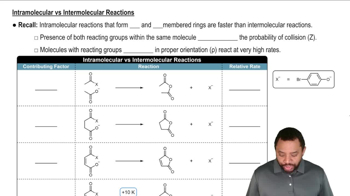
Rates of Intramolecular Reactions Concept 2

Order of Reaction

The order of a reaction refers to the power to which the concentration of a reactant is raised in the rate law. It indicates how the rate of reaction changes with varying concentrations of reactants. In this case, since the rate equation does not include methanol, it implies that the reaction is zero-order with respect to methanol, meaning changes in methanol concentration do not affect the reaction rate.
Video consigliato:
01:42
Proper name ordering and punctuation

Substitution Reactions

Substitution reactions involve the replacement of one functional group in a molecule with another. In the reaction of tert-butyl chloride with methanol, the chlorine atom is replaced by a methoxy group, forming methyl tert-butyl ether. Understanding the mechanism of substitution reactions, including factors like nucleophilicity and sterics, is crucial for predicting the outcome of such reactions.
Video consigliato:
01:34
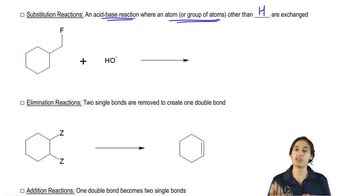
Recognizing Substitution Reactions.