Ch.4 - The Study of Chemical Reactions
Wade - Organic Chemistry 9th Edition
Wade9th EditionOrganic ChemistryISBN: 9780135213728Non è quello che usi tu?Cambia libro di testo
Capitolo 4, Problema 12a

Under certain conditions, the bromination of cyclohexene follows an unusual rate law:

a. What is the kinetic order with respect to cyclohexene?

Guida verificata passo dopo passo
1
Step 1: Analyze the given rate law: rate = k_r[cyclohexene][Br2]^2. The rate law expresses the relationship between the rate of the reaction and the concentrations of the reactants.
Step 2: Identify the reactants in the rate law. The reactants are cyclohexene and bromine (Br2). The exponents in the rate law indicate the order of the reaction with respect to each reactant.
Step 3: Determine the kinetic order with respect to cyclohexene. The exponent of cyclohexene in the rate law is 1, which means the reaction is first-order with respect to cyclohexene.
Step 4: Understand the significance of the kinetic order. A first-order reaction with respect to cyclohexene implies that the rate of the reaction is directly proportional to the concentration of cyclohexene.
Step 5: Note that the overall reaction order can be calculated by summing the orders with respect to all reactants. However, for this specific question, the focus is only on cyclohexene.

Risposta video verificata per un problema simile:

Questa soluzione video è stata consigliata dai nostri tutor come utile per risolvere questo problema.
Durata del video:
1m

Concetti chiave

Ecco i concetti essenziali che devi comprendere per rispondere correttamente alla domanda.

Kinetic Order

Kinetic order refers to the exponent of a concentration term in the rate law of a chemical reaction. It indicates how the rate of reaction is affected by the concentration of a reactant. In this case, the rate law shows that the reaction is first order with respect to cyclohexene, meaning that doubling the concentration of cyclohexene will double the reaction rate.
Video consigliato:
08:51
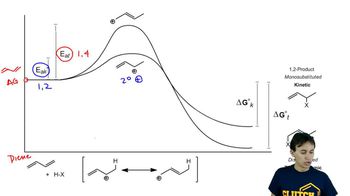
Kinetic vs. Thermodynamic Control

Rate Law

The rate law is an equation that relates the rate of a chemical reaction to the concentration of its reactants. It is expressed in the form of rate = k[A]^m[B]^n, where k is the rate constant, and m and n are the orders of the reaction with respect to reactants A and B, respectively. Understanding the rate law is crucial for determining how changes in concentration affect the reaction rate.
Video consigliato:
Percorso guidato
5:07
Rates of Intramolecular Reactions Concept 2

Bromination of Alkenes

Bromination of alkenes is a common electrophilic addition reaction where bromine (Br2) adds across the double bond of an alkene, such as cyclohexene. This reaction typically proceeds through a cyclic bromonium ion intermediate, which influences the mechanism and rate of the reaction. The unusual rate law in this case suggests a complex mechanism that may involve multiple steps or intermediates.
Video consigliato:
00:54
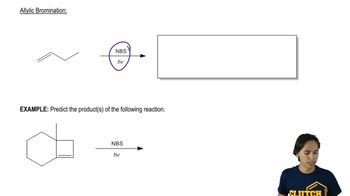
Mechanism of Allylic Bromination.