Ch.4 - The Study of Chemical Reactions
Wade - Organic Chemistry 9th Edition
Wade9th EditionOrganic ChemistryISBN: 9780135213728Non è quello che usi tu?Cambia libro di testo
Capitolo 4, Problema 12b

Under certain conditions, the bromination of cyclohexene follows an unusual rate law:

b. What is the kinetic order with respect to bromine?

Guida verificata passo dopo passo
1
Step 1: Understand the rate law provided in the problem. The rate law is given as rate = k_r[cyclohexene][Br2]^2, where k_r is the rate constant, [cyclohexene] is the concentration of cyclohexene, and [Br2] is the concentration of bromine.
Step 2: Recall the definition of kinetic order with respect to a reactant. The kinetic order is the exponent of the concentration term for that reactant in the rate law. It indicates how the rate of reaction depends on the concentration of that reactant.
Step 3: Identify the exponent of [Br2] in the rate law. In this case, the exponent of [Br2] is 2, as shown in the rate law.
Step 4: Conclude that the kinetic order with respect to bromine (Br2) is determined by this exponent. Therefore, the kinetic order with respect to bromine is 2.
Step 5: Note that the overall reaction order can be calculated by summing the exponents of all reactants in the rate law, but for this specific question, we are only concerned with the kinetic order of bromine.

Risposta video verificata per un problema simile:

Questa soluzione video è stata consigliata dai nostri tutor come utile per risolvere questo problema.
Durata del video:
1m

Concetti chiave

Ecco i concetti essenziali che devi comprendere per rispondere correttamente alla domanda.

Kinetics of Reactions

Chemical kinetics is the study of the rates of chemical reactions and the factors that affect them. It involves understanding how concentration, temperature, and catalysts influence the speed of a reaction. In this case, the rate law indicates how the concentration of reactants affects the rate of bromination of cyclohexene.
Video consigliato:
08:51
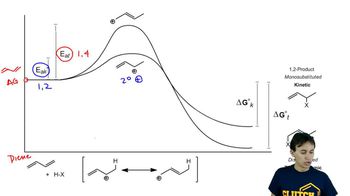
Kinetic vs. Thermodynamic Control

Rate Law

A rate law expresses the relationship between the rate of a chemical reaction and the concentration of its reactants. It is typically formulated as rate = k[A]^m[B]^n, where k is the rate constant, and m and n are the orders of the reaction with respect to reactants A and B. The given rate law for the bromination of cyclohexene shows that the reaction is second order with respect to bromine.
Video consigliato:
Percorso guidato
5:07
Rates of Intramolecular Reactions Concept 2

Order of Reaction

The order of a reaction refers to the power to which the concentration of a reactant is raised in the rate law. It indicates how the rate of reaction changes with varying concentrations of reactants. In this scenario, the rate law suggests that the reaction is first order with respect to cyclohexene and second order with respect to bromine, meaning that doubling the concentration of bromine will quadruple the reaction rate.
Video consigliato:
01:42
Proper name ordering and punctuation
Pratica correlata
Domanda del libro di testo

Under certain conditions, the bromination of cyclohexene follows an unusual rate law:

c. What is the overall kinetic order?

948
views

Domanda del libro di testo

When a small piece of platinum is added to a mixture of ethene and hydrogen, the ­following reaction occurs: Ethene

Doubling the concentration of hydrogen has no effect on the reaction rate. Doubling the concentration of ethene also has no effect.

a. What is the kinetic order of this reaction with respect to ethene? With respect to hydrogen? What is the overall order?

1825
views
Domanda del libro di testo

When a small piece of platinum is added to a mixture of ethene and hydrogen, the ­following reaction occurs:

Doubling the concentration of hydrogen has no effect on the reaction rate. Doubling the concentration of ethene also has no effect.

b. Write the unusual rate equation for this reaction.

c. Explain this strange rate equation, and suggest what one might do to accelerate the reaction.

801
views
Domanda del libro di testo

The reaction of tert-butyl chloride with methanol

is found to follow the rate equation

rate = kr[(CH3)3C—Cl]

c. What is the kinetic order overall

1547
views
Domanda del libro di testo

The reaction of tert-butyl chloride with methanol

is found to follow the rate equation

rate = kr[(CH3)3C—Cl]

b. What is the kinetic order with respect to methanol?

1281
views
Domanda del libro di testo

Under certain conditions, the bromination of cyclohexene follows an unusual rate law:

a. What is the kinetic order with respect to cyclohexene?

1847
views