

Ch.5 - Stereochemistry
Wade - Organic Chemistry 9th Edition
Wade9th EditionOrganic ChemistryISBN: 9780135213728Non è quello che usi tu?Cambia libro di testo
Capitolo 5, Problema 14

One of the crowning achievements of natural products synthesis was Bryostatin 1, published by Professor Gary Keck (University of Utah; Journal of the American Chemical Society, 2011, 133, 744–747). The Bryostatins are a family of compounds isolated from aquatic invertebrates known as Bryozoans. The compounds are of interest for a variety of biological effects, including anti-cancer activity and reversing brain damage in rodents. (d) How many chiral centers are in this molecule? (e) Using the number of chiral centers you reported in part (d), calculate the number of stereoisomers possible at these chiral centers. (Ignore stereoisomers at double bonds.)

Guida verificata passo dopo passo
1
Identify all the chiral centers in the Bryostatin 1 molecule. A chiral center is typically a carbon atom that is bonded to four different groups.
Count the number of chiral centers identified in the molecule.
Use the formula for calculating the number of stereoisomers: 2^n, where n is the number of chiral centers.
Substitute the number of chiral centers found in step 2 into the formula from step 3.
Calculate the number of possible stereoisomers based on the formula.

Risposta video verificata per un problema simile:

Questa soluzione video è stata consigliata dai nostri tutor come utile per risolvere questo problema.
Durata del video:
2m

Concetti chiave

Ecco i concetti essenziali che devi comprendere per rispondere correttamente alla domanda.

Chirality

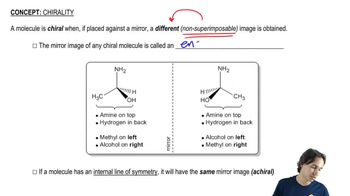
Chirality refers to the geometric property of a molecule that makes it non-superimposable on its mirror image, much like left and right hands. A chiral center, typically a carbon atom, is bonded to four different substituents, leading to two distinct configurations known as enantiomers. Understanding chirality is crucial for determining the spatial arrangement of atoms in a molecule, which directly influences its chemical behavior and biological activity.
Video consigliato:
05:10
What is chirality?

Stereoisomers

Stereoisomers are compounds that have the same molecular formula and connectivity of atoms but differ in the spatial arrangement of their atoms. This category includes enantiomers, which are mirror images of each other, and diastereomers, which are not. The number of stereoisomers for a molecule can be calculated using the formula 2^n, where n is the number of chiral centers, highlighting the complexity and diversity of potential molecular configurations.
Video consigliato:
01:58
Determining when molecules are stereoisomers.

Calculating Stereoisomers

To calculate the number of stereoisomers for a molecule with chiral centers, one can use the formula 2^n, where n represents the number of chiral centers present. This formula assumes that all chiral centers are independent and can exist in both configurations (R and S). It is important to note that this calculation does not account for any symmetry in the molecule, which could reduce the total number of unique stereoisomers.
Video consigliato:
01:58
Determining when molecules are stereoisomers.
Pratica correlata
Domanda del libro di testo

Draw three-dimensional representations of the following compounds. Which have asymmetric carbon atoms? Which have no asymmetric carbons but are chiral anyway? Use your models for parts (a) through (d) and any others that seem unclear.

(c)

(d)

824
views
Domanda del libro di testo

A chemist finds that the addition of (+)-epinephrine to the catalytic reduction of butan-2-one (Figure 5-17 ) gives a product that is slightly optically active, with a specific rotation of +0.45°. Calculate the percentages of (+)-butan-2-ol and (−)-butan-2-ol formed in this reaction.

1637
views
Domanda del libro di testo

When optically pure (R)-2-bromobutane is heated with water, butan-2-ol is the product. The reaction forms twice as much (S)-butan-2-ol as (R)-butan-2-ol. Calculate the e.e. and the specific rotation expected for the product.

1199
views
Domanda del libro di testo

If you had the two enantiomers of carvone in unmarked bottles, could you use just your nose and a polarimeter to determine

a. whether it is the (+) or (−) enantiomer that smells like spearmint

b. whether it is the (R) or (S) enantiomer that smells like spearmint?

c. With the information given in the drawings of carvone above, what can you add to your answers to (a) and (b)?

2573
views
Domanda del libro di testo

Make a model of each compound, draw it in its most symmetric conformation, and determine whether it is capable of showing optical activity.

a. 1-bromo-1-chloroethane

b. 1-bromo-2-chloroethane

1591
views
Domanda del libro di testo

Draw three-dimensional representations of the following compounds. Which have asymmetric carbon atoms? Which have no asymmetric carbons but are chiral anyway? Use your models for parts (a) through (d) and any others that seem unclear.

(a)

(b)

1001
views