Ch. 7 - Structure and Synthesis of Alkenes; Elimination
Wade - Organic Chemistry 9th Edition
Wade9th EditionOrganic ChemistryISBN: 9780135213728Non è quello che usi tu?Cambia libro di testo
Capitolo 7, Problema 71

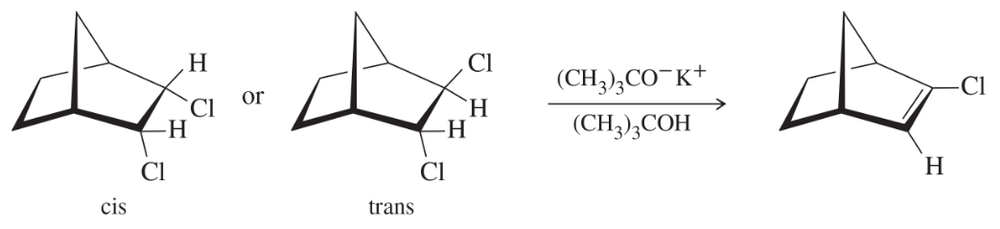
One of the following dichloronorbornanes undergoes elimination much faster than the other. Determine which one reacts faster, and explain the large difference in rates.

Guida verificata passo dopo passo
1
Step 1: Analyze the structures of the cis- and trans-dichloronorbornanes. The cis isomer has both chlorine atoms on the same side of the bicyclic ring system, while the trans isomer has the chlorine atoms on opposite sides of the ring system.
Step 2: Consider the elimination reaction mechanism. The reaction involves the removal of a hydrogen atom and a chlorine atom to form a double bond. This is typically an E2 elimination mechanism, which requires the hydrogen and chlorine atoms to be anti-periplanar (i.e., opposite sides of the same plane).
Step 3: Evaluate the geometry of the cis isomer. In the cis isomer, the hydrogen atom and chlorine atom that are candidates for elimination are not anti-periplanar due to the rigid bicyclic structure. This makes elimination less favorable.
Step 4: Evaluate the geometry of the trans isomer. In the trans isomer, the hydrogen atom and chlorine atom are anti-periplanar, which aligns perfectly for the E2 elimination mechanism. This makes elimination much faster for the trans isomer.
Step 5: Conclude that the trans isomer undergoes elimination much faster than the cis isomer due to the anti-periplanar geometry required for the E2 mechanism, which is achievable in the trans isomer but not in the cis isomer.

Risposta video verificata per un problema simile:

Questa soluzione video è stata consigliata dai nostri tutor come utile per risolvere questo problema.
Durata del video:
4m

Concetti chiave

Ecco i concetti essenziali che devi comprendere per rispondere correttamente alla domanda.

Elimination Reactions

Elimination reactions involve the removal of a small molecule from a larger one, typically resulting in the formation of a double bond. In organic chemistry, these reactions can follow either an E1 or E2 mechanism, which differ in their steps and conditions. Understanding the mechanism is crucial for predicting the rate and outcome of the reaction.
Video consigliato:
00:40
Recognizing Elimination Reactions.

Steric Hindrance

Steric hindrance refers to the repulsion between bulky groups in a molecule that can impede reactions. In the context of elimination reactions, steric hindrance can affect the accessibility of the leaving group and the formation of the double bond. The spatial arrangement of substituents, such as in cis and trans isomers, plays a significant role in determining the reaction rate.
Video consigliato:
02:53
Understanding steric effects.

Cis-Trans Isomerism

Cis-trans isomerism is a form of stereoisomerism where the relative positioning of substituents differs around a double bond or a ring structure. In the case of dichloronorbornanes, the cis isomer may allow for a more favorable transition state during elimination due to less steric hindrance compared to the trans isomer, leading to a faster reaction rate.
Video consigliato:
00:44
Is the following cyclohexane cis or trans?
Pratica correlata
Domanda del libro di testo

When 2-bromo-3-phenylbutane is treated with sodium methoxide, two alkenes result (by E2 elimination). The Zaitsev product predominates.

a. Draw the reaction, showing the major and minor products.

1666
views

Domanda del libro di testo

Write a mechanism that explains the formation of the following product. In your mechanism, explain the cause of the rearrangement, and explain the failure to form the Zaitsev product.

962
views
Domanda del libro di testo

Explain the dramatic difference in rotational energy barriers of the following three alkenes. (Hint: Consider what the transition states must look like.)

1493
views
Domanda del libro di testo

The following reaction is called the pinacol rearrangement. The reaction begins with an acid-promoted ionization to give a carbocation. This carbocation undergoes a methyl shift to give a more stable, resonance-stabilized cation. Loss of a proton gives the observed product. Propose a mechanism for the pinacol rearrangement.

1787
views
Domanda del libro di testo

Deuterium (D) is the isotope of hydrogen of mass number 2, with a proton and a neutron in its nucleus. The chemistry of deuterium is nearly identical to the chemistry of hydrogen, except that the C―D bond is slightly (5.0 kJ/mol, or 1.2 kcal/mol) stronger than the C―H bond. Reaction rates tend to be slower if a C―D bond (as opposed to a C―H bond) is broken in a rate-limiting step. This effect on the rate is called a kinetic isotope effect. (Review PROBLEM 4-57)

a. Propose a mechanism to explain each product in the following reaction.

1453
views
Domanda del libro di testo

When 2-bromo-3-phenylbutane is treated with sodium methoxide, two alkenes result (by E2 elimination). The Zaitsev product predominates.

b. When one pure stereoisomer of 2-bromo-3-phenylbutane reacts, one pure stereoisomer of the major product results. For example, when (2R,3R)-2-bromo-3-phenylbutane reacts, the product is the stereoisomer with the methyl groups cis. Use your models to draw a Newman projection of the transition state to show why this stereospecificity is observed.

c. Use a Newman projection of the transition state to predict the major product of elimination of (2S,3R)-2-bromo-3-phenylbutane.

d. Predict the major product from elimination of (2S,3S)-2-bromo-3-phenylbutane. This prediction can be made without drawing any structures, by considering the results in part (b).

2591
views
1
comments