Ch. 7 - Structure and Synthesis of Alkenes; Elimination
Wade - Organic Chemistry 9th Edition
Wade9th EditionOrganic ChemistryISBN: 9780135213728Non è quello che usi tu?Cambia libro di testo
Capitolo 7, Problema 33h

Predict the products and mechanisms of the following reactions. When more than one product or mechanism is possible, explain which are most likely.
h. 1-bromo-1-methylcyclopentane heated in methanol

Guida verificata passo dopo passo
1
Step 1: Analyze the structure of the reactant, 1-bromo-1-methylcyclopentane. The molecule contains a bromine atom attached to a tertiary carbon (1-methylcyclopentane), which makes it prone to undergo substitution or elimination reactions.
Step 2: Consider the reaction conditions. The presence of methanol (CH3OH) as a solvent and heat suggests that the reaction may proceed via an SN1 (substitution) or E1 (elimination) mechanism, as tertiary carbons favor these pathways due to the stability of the carbocation intermediate.
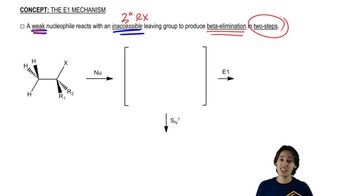
Step 3: Predict the mechanism. In an SN1 mechanism, the bromine atom leaves first, forming a tertiary carbocation. Methanol can then act as a nucleophile, attacking the carbocation to form a substitution product (e.g., a methoxy group replacing bromine). In an E1 mechanism, the bromine atom leaves, forming a carbocation, followed by elimination of a proton from a β-carbon to form an alkene.
Step 4: Evaluate the likelihood of products. The SN1 product (substitution) is likely if methanol acts as a nucleophile. The E1 product (elimination) is likely if heat promotes the formation of an alkene. Both products may form, but elimination is often favored under heated conditions.
Step 5: Consider regioselectivity and stereoselectivity. For the E1 mechanism, the most stable alkene product will form due to Zaitsev's rule, favoring the more substituted double bond. For the SN1 mechanism, the stereochemistry of the product will depend on the attack of methanol on the planar carbocation intermediate.

Risposta video verificata per un problema simile:

Questa soluzione video è stata consigliata dai nostri tutor come utile per risolvere questo problema.
Durata del video:
11m

Concetti chiave

Ecco i concetti essenziali che devi comprendere per rispondere correttamente alla domanda.

Elimination Reactions

Elimination reactions involve the removal of a leaving group and a hydrogen atom from adjacent carbon atoms, resulting in the formation of a double bond. In this case, heating 1-bromo-1-methylcyclopentane in methanol can lead to either E2 or E1 elimination mechanisms, depending on the conditions and the stability of the intermediates formed.
Video consigliato:
00:40
Recognizing Elimination Reactions.

Mechanism Types: E1 vs. E2

E1 and E2 are two distinct mechanisms for elimination reactions. E1 is a two-step process involving the formation of a carbocation intermediate, while E2 is a one-step concerted process where the base abstracts a proton as the leaving group departs. The choice between these mechanisms often depends on the substrate structure and the reaction conditions, such as the presence of a strong base or heat.
Video consigliato:
08:09
Drawing the E1 Mechanism.

Regioselectivity and Stereochemistry

Regioselectivity refers to the preference for the formation of one constitutional isomer over others, while stereochemistry involves the spatial arrangement of atoms in the product. In the case of 1-bromo-1-methylcyclopentane, the elimination can yield different alkenes, and understanding the stability of these products, as well as the stereochemical outcomes, is crucial for predicting the major products of the reaction.
Video consigliato:
Percorso guidato
1:38
Polymer Stereochemistry Concept 1