Ch. 7 - Structure and Synthesis of Alkenes; Elimination
Wade - Organic Chemistry 9th Edition
Wade9th EditionOrganic ChemistryISBN: 9780135213728Non è quello che usi tu?Cambia libro di testo
Capitolo 7, Problema 74

The following reaction is called the pinacol rearrangement. The reaction begins with an acid-promoted ionization to give a carbocation. This carbocation undergoes a methyl shift to give a more stable, resonance-stabilized cation. Loss of a proton gives the observed product. Propose a mechanism for the pinacol rearrangement.

Guida verificata passo dopo passo
1
Step 1: Protonation of one of the hydroxyl groups occurs in the presence of sulfuric acid (H2SO4). This converts the hydroxyl group into a better leaving group, forming water.
Step 2: The water molecule leaves, generating a carbocation at the carbon where the hydroxyl group was initially attached. This carbocation is relatively unstable.
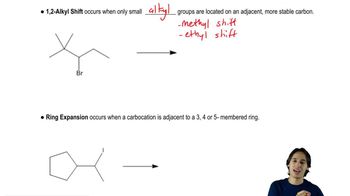
Step 3: A methyl group undergoes a 1,2-shift (methyl migration) to stabilize the carbocation. This results in the formation of a resonance-stabilized tertiary carbocation.
Step 4: A deprotonation step occurs, where a proton is removed from the carbocation intermediate. This leads to the formation of a ketone group (C=O) at the migrated carbon.
Step 5: The final product, pinacolone (H3CC(=O)C(CH3)3), is formed as a result of the rearrangement and stabilization of the molecule.

Risposta video verificata per un problema simile:

Questa soluzione video è stata consigliata dai nostri tutor come utile per risolvere questo problema.
Durata del video:
4m

Concetti chiave

Ecco i concetti essenziali che devi comprendere per rispondere correttamente alla domanda.

Carbocation Stability

Carbocations are positively charged species that are highly reactive. Their stability is influenced by the degree of substitution; tertiary carbocations are more stable than secondary or primary ones due to hyperconjugation and inductive effects. In the pinacol rearrangement, the formation of a more stable carbocation through a methyl shift is crucial for the reaction's progression.
Video consigliato:
05:58
Determining Carbocation Stability

Methyl Shift

A methyl shift is a type of rearrangement where a methyl group moves from one carbon to an adjacent carbon, resulting in the formation of a more stable carbocation. This process is essential in the pinacol rearrangement, as it allows the reaction to proceed through a more stable intermediate, ultimately leading to the formation of the product, pinacolone.
Video consigliato:
03:43
Alkyl Shift

Acid-Catalyzed Rearrangement

The pinacol rearrangement is an acid-catalyzed reaction, meaning that the presence of an acid (like H2SO4) facilitates the ionization of the starting material, pinacol. This ionization generates a carbocation, which is a key intermediate in the reaction mechanism. The acid not only promotes the formation of the carbocation but also helps in the subsequent steps leading to the final product.
Video consigliato:
03:09
Acid Catalyzed
Pratica correlata
Domanda del libro di testo

Write a mechanism that explains the formation of the following product. In your mechanism, explain the cause of the rearrangement, and explain the failure to form the Zaitsev product.

962
views

Domanda del libro di testo

Explain the dramatic difference in rotational energy barriers of the following three alkenes. (Hint: Consider what the transition states must look like.)

1493
views
Domanda del libro di testo

One of the following dichloronorbornanes undergoes elimination much faster than the other. Determine which one reacts faster, and explain the large difference in rates.

1057
views
Domanda del libro di testo

When the following compound is treated with sodium methoxide in methanol, two elimination products are possible. Explain why the deuterated product predominates by about a 7:1 ratio (refer to Problem 7-75).

3653
views
Domanda del libro di testo

Deuterium (D) is the isotope of hydrogen of mass number 2, with a proton and a neutron in its nucleus. The chemistry of deuterium is nearly identical to the chemistry of hydrogen, except that the C―D bond is slightly (5.0 kJ/mol, or 1.2 kcal/mol) stronger than the C―H bond. Reaction rates tend to be slower if a C―D bond (as opposed to a C―H bond) is broken in a rate-limiting step. This effect on the rate is called a kinetic isotope effect. (Review Problem 4-57)

b. When the following deuterated compound reacts under the same conditions, the rate of formation of the substitution product is unchanged, while the rate of formation of the elimination product is slowed by a factor of 7.

Explain why the elimination rate is slower, but the substitution rate is unchanged.

1137
views
Domanda del libro di testo

Deuterium (D) is the isotope of hydrogen of mass number 2, with a proton and a neutron in its nucleus. The chemistry of deuterium is nearly identical to the chemistry of hydrogen, except that the C―D bond is slightly (5.0 kJ/mol, or 1.2 kcal/mol) stronger than the C―H bond. Reaction rates tend to be slower if a C―D bond (as opposed to a C―H bond) is broken in a rate-limiting step. This effect on the rate is called a kinetic isotope effect. (Review PROBLEM 4-57)

a. Propose a mechanism to explain each product in the following reaction.

1453
views