


Ch.8 - Reactions of Alkenes
Wade - Organic Chemistry 9th Edition
Wade9th EditionOrganic ChemistryISBN: 9780135213728Non è quello che usi tu?Cambia libro di testo
Capitolo 8, Problema 37f

Predict the major products of the following reactions.
f. 1-ethylcycloheptene + cold, dilute KMnO4

Guida verificata passo dopo passo
1
Identify the type of reaction: Cold, dilute KMnO4 is a reagent used for syn-dihydroxylation of alkenes. This reaction adds two hydroxyl (-OH) groups across the double bond in a syn (same side) fashion.
Locate the double bond in the given molecule: 1-ethylcycloheptene contains a double bond in the cycloheptene ring. The double bond is the site of the reaction.
Determine the stereochemistry of the addition: Since cold, dilute KMnO4 performs syn addition, the two hydroxyl groups will be added to the same face of the double bond.
Draw the intermediate structure: Break the π-bond of the double bond and add one hydroxyl group to each of the two carbons that were part of the double bond. Ensure that both hydroxyl groups are on the same side of the ring.
Verify the product: Confirm that the product is a 1,2-diol (vicinal diol) with the hydroxyl groups added in a syn fashion. The ethyl group on the cycloheptene ring remains unchanged.

Risposta video verificata per un problema simile:

Questa soluzione video è stata consigliata dai nostri tutor come utile per risolvere questo problema.
Durata del video:
3m

Concetti chiave

Ecco i concetti essenziali che devi comprendere per rispondere correttamente alla domanda.

Electrophilic Addition Reactions

Electrophilic addition reactions involve the addition of electrophiles to alkenes, where the double bond acts as a nucleophile. In the case of 1-ethylcycloheptene, the double bond can react with cold, dilute KMnO4, which serves as an electrophile, leading to the formation of a diol through syn-dihydroxylation.
Video consigliato:
05:39
Features of Addition Mechanisms.

Oxidation Reactions

Oxidation reactions in organic chemistry refer to the process where a molecule loses electrons, often involving the addition of oxygen or the removal of hydrogen. KMnO4 is a strong oxidizing agent, and in cold, dilute conditions, it selectively oxidizes alkenes to form vicinal diols, which are compounds with hydroxyl groups on adjacent carbon atoms.
Video consigliato:
03:20
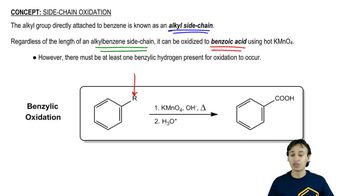
Benzylic Oxidation

Regioselectivity and Stereochemistry

Regioselectivity refers to the preference of a chemical reaction to yield one structural isomer over others, while stereochemistry deals with the spatial arrangement of atoms in molecules. In the reaction of 1-ethylcycloheptene with KMnO4, the regioselectivity will determine which carbon atoms are oxidized, and the stereochemistry will dictate whether the resulting diol is formed in a syn or anti manner.
Video consigliato:
Percorso guidato
1:38
Polymer Stereochemistry Concept 1