Ch.8 - Reactions of Alkenes
Wade - Organic Chemistry 9th Edition
Wade9th EditionOrganic ChemistryISBN: 9780135213728Non è quello che usi tu?Cambia libro di testo
Capitolo 8, Problema 19

Propose a mechanism for the addition of bromine water to cyclopentene, being careful to show why the trans product results and how both enantiomers are formed.

Guida verificata passo dopo passo
1
Identify the starting material and reagent: The starting material is cyclopentene, a cyclic alkene, and the reagent is bromine water (Br₂ in H₂O). This reaction involves an electrophilic addition mechanism.
Step 1: Formation of the bromonium ion intermediate. The π-electrons of the double bond in cyclopentene attack one of the bromine atoms in Br₂, forming a cyclic bromonium ion intermediate. This step creates a three-membered ring with a positive charge on the bromine atom, while the other bromine atom becomes a bromide ion (Br⁻).
Step 2: Nucleophilic attack by water. The bromonium ion is highly strained and electrophilic, so water (a nucleophile) attacks one of the carbon atoms in the bromonium ion. This attack occurs at the carbon atom that is more accessible (anti to the bromine atom in the ring), leading to the opening of the bromonium ring.
Step 3: Formation of the trans product. The anti-addition of water and bromine ensures that the two substituents (Br and OH) are added to opposite sides of the cyclopentane ring. This anti-addition is due to the backside attack of water on the bromonium ion, which avoids steric hindrance.
Step 4: Formation of enantiomers. Since the attack by water can occur on either side of the plane of the molecule, two enantiomers are formed. These enantiomers are non-superimposable mirror images of each other, resulting in a racemic mixture of the trans product.

Risposta video verificata per un problema simile:

Questa soluzione video è stata consigliata dai nostri tutor come utile per risolvere questo problema.
Durata del video:
10m

Concetti chiave

Ecco i concetti essenziali che devi comprendere per rispondere correttamente alla domanda.

Electrophilic Addition Mechanism

The addition of bromine to cyclopentene involves an electrophilic addition mechanism, where the double bond acts as a nucleophile, attacking the bromine molecule. This results in the formation of a cyclic bromonium ion intermediate, which is crucial for determining the stereochemistry of the final products.
Video consigliato:
05:39
Features of Addition Mechanisms.

Stereochemistry and Trans Product Formation

The formation of the trans product occurs due to the backside attack of the bromide ion on the bromonium ion intermediate. This attack leads to the opening of the three-membered ring in a way that results in anti-addition, producing a trans-dibromide product, which is more stable due to reduced steric hindrance.
Video consigliato:
Percorso guidato
1:38
Polymer Stereochemistry Concept 1

Enantiomers and Chiral Centers

The reaction can produce both enantiomers because the addition of bromine creates a chiral center in the product. Since the bromonium ion can be attacked from either side, two different configurations (R and S) can be formed, resulting in a racemic mixture of enantiomers in the final product.
Video consigliato:
03:44
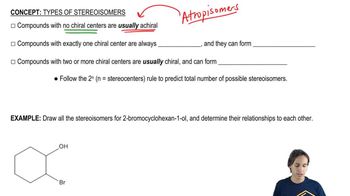
Using chiral centers to predict types of stereoisomers.
Pratica correlata
Domanda del libro di testo

When 1,2-dimethylcyclopentene undergoes hydroboration–oxidation, one diastereomer of the product predominates. Show why this addition is stereospecific, and predict the stereochemistry of the major product.

1443
views

Domanda del libro di testo

Give mechanisms to account for the stereochemistry of the products observed from the addition of bromine to cis- and trans-but-2-ene (Figure 8-5). Why are two products formed from the cis isomer but only one from the trans? (Making models will be ­helpful.)

2064
views
Domanda del libro di testo

Propose mechanisms and predict the major products of the following reactions. Include stereochemistry where appropriate.

(c) (E)-dec-3-ene + Br2 in CCl4

(d) (Z)-dec-3-ene + Br2 in CCl4

Problem-Solving Hint: Models may be helpful whenever stereochemistry is involved. Write complete structures, including all bonds and charges, when writing mechanisms.

1749
views
1
rank
Domanda del libro di testo

The solutions to Solved Problem 8-5 showed only how one enantiomer of the product is formed. For each product, show how an equally probable reaction forms the other enantiomer.

1316
views
Domanda del libro di testo

The solutions to Solved Problem 8-6 showed only how one enantiomer of the product is formed. For each product, show how an equally probable reaction forms the other enantiomer.

1244
views
Domanda del libro di testo

Predict the major product(s) for each reaction. Include stereochemistry where appropriate.

a. 1-methylcyclohexene + Cl2/H2O

b. 2-methylbut-2-ene + Br2/H2O

2009
views