Ch.8 - Reactions of Alkenes
Wade - Organic Chemistry 9th Edition
Wade9th EditionOrganic ChemistryISBN: 9780135213728Non è quello che usi tu?Cambia libro di testo
Capitolo 8, Problema 28a

Show how you would accomplish each of the following synthetic conversions. 
a. trans-but-2-ene → trans-1,2-dimethylcyclopropane

Guida verificata passo dopo passo
1
Step 1: Recognize that the transformation involves converting a trans-alkene (trans-but-2-ene) into a cyclopropane ring. This suggests the use of a cyclopropanation reaction, which typically involves a carbene or carbenoid intermediate.
Step 2: Select a reagent that can generate a carbene or carbenoid. A common choice is a dihalocarbene, which can be formed using a haloform (e.g., CHCl₃) and a strong base (e.g., NaOH). Alternatively, Simmons-Smith reagents (e.g., CH₂I₂ with Zn(Cu)) can be used for cyclopropanation.
Step 3: If using the Simmons-Smith reaction, treat trans-but-2-ene with CH₂I₂ and Zn(Cu) in an inert solvent like diethyl ether. This reagent selectively adds a CH₂ group across the double bond, forming a cyclopropane ring while preserving the stereochemistry of the starting material.
Step 4: Ensure that the stereochemistry of the product matches the starting material. Since the starting alkene is trans, the resulting cyclopropane will also have trans stereochemistry (trans-1,2-dimethylcyclopropane).
Step 5: Verify the product structure by confirming that the two methyl groups on the cyclopropane ring are on opposite sides, consistent with the trans configuration of the starting alkene.

Risposta video verificata per un problema simile:

Questa soluzione video è stata consigliata dai nostri tutor come utile per risolvere questo problema.
Durata del video:
3m

Concetti chiave

Ecco i concetti essenziali che devi comprendere per rispondere correttamente alla domanda.

Elimination Reactions

Elimination reactions involve the removal of atoms or groups from a molecule, resulting in the formation of a double bond or a ring structure. In the context of converting trans-but-2-ene to trans-1,2-dimethylcyclopropane, understanding how to perform elimination reactions is crucial for creating the necessary double bond that can then be transformed into a cyclic structure.
Video consigliato:
00:40
Recognizing Elimination Reactions.

Cyclopropanation

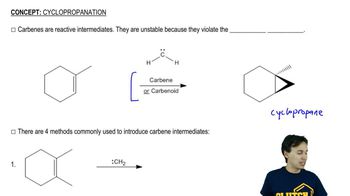
Cyclopropanation is a reaction that involves the formation of a cyclopropane ring from alkenes. This process typically utilizes reagents such as diazomethane or other cyclopropanating agents. Recognizing how to apply cyclopropanation to the double bond in trans-but-2-ene is essential for synthesizing trans-1,2-dimethylcyclopropane.
Video consigliato:
01:49
General properties of cyclopropanation.

Stereochemistry

Stereochemistry is the study of the spatial arrangement of atoms in molecules and how this affects their chemical behavior. In the conversion of trans-but-2-ene to trans-1,2-dimethylcyclopropane, it is important to consider the stereochemical implications of the reactions involved to ensure that the final product retains the desired trans configuration.
Video consigliato:
Percorso guidato
1:38
Polymer Stereochemistry Concept 1