Ch.8 - Reactions of Alkenes
Wade - Organic Chemistry 9th Edition
Wade9th EditionOrganic ChemistryISBN: 9780135213728Non è quello che usi tu?Cambia libro di testo
Capitolo 8, Problema 28b

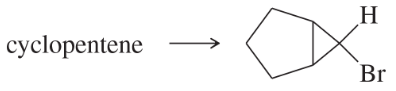
Show how you would accomplish each of the following synthetic conversions.
(b)

Guida verificata passo dopo passo
1
Step 1: Begin with cyclopentene, which contains a double bond. The goal is to convert this into a bicyclic structure with a chlorine atom attached.
Step 2: Perform a halogenation reaction using chlorine gas (Cl₂) in the presence of UV light or heat. This will add a chlorine atom to the allylic position of cyclopentene, forming allyl chloride.
Step 3: Use a Diels-Alder reaction to form the bicyclic structure. React the allyl chloride with a suitable dienophile, such as maleic anhydride, under heat to form the bicyclic intermediate.
Step 4: Perform a selective elimination or rearrangement reaction to remove any unwanted substituents and ensure the chlorine atom is positioned correctly on the bicyclic structure.
Step 5: Purify the final product using techniques such as distillation or recrystallization to isolate the desired bicyclic compound with the chlorine atom attached.

Risposta video verificata per un problema simile:

Questa soluzione video è stata consigliata dai nostri tutor come utile per risolvere questo problema.
Durata del video:
10m

Concetti chiave

Ecco i concetti essenziali che devi comprendere per rispondere correttamente alla domanda.

Electrophilic Addition Reactions

Electrophilic addition reactions are a fundamental type of reaction in organic chemistry where an electrophile reacts with a nucleophile, resulting in the addition of atoms or groups across a double bond. In the case of cyclopentene, the double bond acts as a nucleophile, allowing for the addition of electrophiles such as halogens. This process is crucial for converting alkenes into more complex structures, such as chlorinated products.
Video consigliato:
05:39
Features of Addition Mechanisms.

Regioselectivity

Regioselectivity refers to the preference of a chemical reaction to yield one structural isomer over others when multiple possibilities exist. In the chlorination of cyclopentene, the regioselectivity will determine which carbon atom in the double bond will bond with the chlorine atom. Understanding regioselectivity is essential for predicting the outcome of synthetic conversions and ensuring the desired product is formed.
Video consigliato:
05:09
Heck Reaction

Mechanism of Halogenation

The mechanism of halogenation involves the formation of a cyclic halonium ion intermediate when a halogen (like Cl2) adds to an alkene. This intermediate is crucial as it influences the stereochemistry and regioselectivity of the final product. Recognizing this mechanism helps in understanding how cyclopentene can be transformed into a chlorinated product, as it outlines the steps and intermediates involved in the reaction.
Video consigliato:
03:45
Halogenation Mechanism