Ch.8 - Reactions of Alkenes
Wade - Organic Chemistry 9th Edition
Wade9th EditionOrganic ChemistryISBN: 9780135213728Non è quello che usi tu?Cambia libro di testo
Capitolo 8, Problema 28c

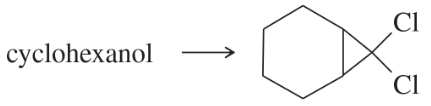
Show how you would accomplish each of the following synthetic conversions.
(c)

Guida verificata passo dopo passo
1
Step 1: Convert cyclohexanol to cyclohexene by performing an acid-catalyzed dehydration reaction. Use a strong acid like H2SO4 or H3PO4 to remove water and form the double bond.
Step 2: Perform a halogenation reaction on cyclohexene. React cyclohexene with Cl2 in an inert solvent like CCl4 to add two chlorine atoms across the double bond, forming 1,2-dichlorocyclohexane.
Step 3: Ensure stereochemistry is considered during the halogenation step. The addition of Cl2 will proceed via a cyclic halonium ion intermediate, leading to anti-addition of chlorine atoms.
Step 4: Verify the product structure to ensure it matches the desired 1,2-dichlorocyclohexane with the correct stereochemistry.
Step 5: Purify the product using techniques like distillation or recrystallization, if necessary, to isolate the final compound.

Risposta video verificata per un problema simile:

Questa soluzione video è stata consigliata dai nostri tutor come utile per risolvere questo problema.
Durata del video:
5m

Concetti chiave

Ecco i concetti essenziali che devi comprendere per rispondere correttamente alla domanda.

Nucleophilic Substitution

Nucleophilic substitution is a fundamental reaction in organic chemistry where a nucleophile attacks an electrophile, resulting in the replacement of a leaving group. In the context of converting cyclohexanol to a dichlorinated product, the hydroxyl group (-OH) of cyclohexanol can be replaced by chlorine atoms through a nucleophilic substitution mechanism, typically involving reagents like thionyl chloride (SOCl2) or phosphorus trichloride (PCl3).
Video consigliato:
01:47
Nucleophiles and Electrophiles can react in Substitution Reactions.

Reactivity of Alcohols

Alcohols, such as cyclohexanol, are reactive compounds that can undergo various transformations. The hydroxyl group in alcohols can be converted into better leaving groups, facilitating substitution reactions. Understanding the reactivity of alcohols is crucial for predicting the outcome of synthetic conversions, including the formation of chlorinated derivatives.
Video consigliato:
01:01
How to name alcohols

Stereochemistry

Stereochemistry refers to the spatial arrangement of atoms in molecules and how this affects their chemical behavior. In the conversion of cyclohexanol to a dichlorinated product, the stereochemistry of the resulting compound is important, as the position of the chlorine atoms can lead to different isomers. Recognizing the stereochemical implications of reactions helps in understanding the properties and reactivity of the final product.
Video consigliato:
Percorso guidato
1:38
Polymer Stereochemistry Concept 1