Ch.6 - Alkyl Halides; Nucleophilic Substitution
Wade - Organic Chemistry 9th Edition
Wade9th EditionOrganic ChemistryISBN: 9780135213728Non è quello che usi tu?Cambia libro di testo
Capitolo 6, Problema 25d

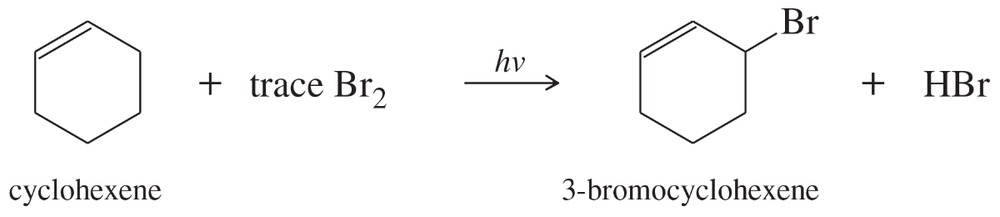
In the presence of a small amount of bromine, cyclohexene undergoes the following light-promoted reaction:

d. Explain why cyclohexene reacts with bromine much faster than cyclohexane, which must be heated to react.

Guida verificata passo dopo passo
1
Cyclohexene contains a double bond, which is an area of high electron density. This makes it more reactive toward electrophiles like bromine compared to cyclohexane, which lacks a double bond and is less reactive.
In the presence of light (hv), bromine undergoes homolytic cleavage to form bromine radicals. These radicals initiate a chain reaction with cyclohexene.
The double bond in cyclohexene allows for the formation of a more stable allylic radical during the reaction. This stability arises from resonance delocalization of the unpaired electron over the π-system of the double bond.
Cyclohexane, on the other hand, does not have a double bond and cannot form a resonance-stabilized radical. As a result, its reaction with bromine requires higher energy input, such as heating, to proceed.
The reaction of cyclohexene with bromine is faster because the allylic radical intermediate is stabilized, lowering the activation energy for the reaction and making it more favorable under light-promoted conditions.

Risposta video verificata per un problema simile:

Questa soluzione video è stata consigliata dai nostri tutor come utile per risolvere questo problema.
Durata del video:
3m

Concetti chiave

Ecco i concetti essenziali che devi comprendere per rispondere correttamente alla domanda.

Electrophilic Addition

Electrophilic addition is a fundamental reaction mechanism in organic chemistry where an electrophile reacts with a nucleophile, leading to the formation of a more saturated product. In the case of cyclohexene, the double bond acts as a nucleophile, readily reacting with bromine, an electrophile, to form bromocyclohexene. This reaction is favored due to the stability of the carbocation intermediate formed during the process.
Video consigliato:
09:23
1,2 vs 1,4 Addition

Stability of Alkenes vs. Alkanes

Alkenes, such as cyclohexene, are generally more reactive than alkanes like cyclohexane due to the presence of a carbon-carbon double bond. This double bond is a site of high electron density, making alkenes more susceptible to electrophilic attack. In contrast, alkanes are saturated hydrocarbons with only single bonds, requiring higher energy conditions, such as heat, to initiate reactions with electrophiles like bromine.
Video consigliato:
04:28
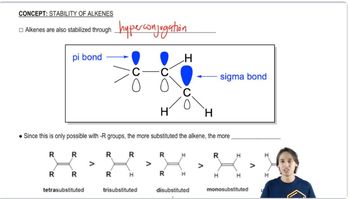
Understanding trends of alkene stability.

Reaction Conditions and Activation Energy

The reaction conditions significantly influence the rate of chemical reactions. Cyclohexene reacts with bromine under mild conditions due to its lower activation energy, allowing the reaction to proceed at room temperature or with light. Conversely, cyclohexane requires heating to provide the necessary energy to overcome the activation barrier for bromination, making it less reactive under standard conditions.
Video consigliato:
08:30
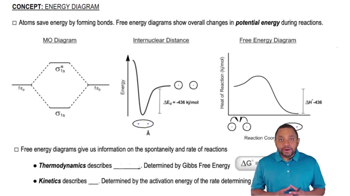
Introduction to free energy diagrams.
Pratica correlata