Ch.6 - Alkyl Halides; Nucleophilic Substitution
Wade - Organic Chemistry 9th Edition
Wade9th EditionOrganic ChemistryISBN: 9780135213728Non è quello che usi tu?Cambia libro di testo
Capitolo 6, Problema 15c,d

Show how you might use SN2 reactions to convert 1-chlorobutane into the following compounds.
c. 1-iodobutane
d. CH3—(CH2)3—CN

Guida verificata passo dopo passo
1
Step 1: Understand the SN2 reaction mechanism. SN2 reactions involve a single-step nucleophilic substitution where the nucleophile attacks the electrophilic carbon and simultaneously displaces the leaving group. This reaction is favored in primary alkyl halides like 1-chlorobutane.
Step 2: For part c (conversion to 1-iodobutane), select an appropriate nucleophile. Use iodide ion (I⁻) as the nucleophile because it is a strong nucleophile and can replace the chlorine atom in 1-chlorobutane. The reaction can be carried out in a polar aprotic solvent like acetone to favor the SN2 mechanism.
Step 3: Write the reaction for part c. The iodide ion attacks the carbon bonded to chlorine in 1-chlorobutane, displacing the chloride ion (Cl⁻) and forming 1-iodobutane. The reaction can be represented as: CH₃(CH₂)₃Cl + I⁻ → CH₃(CH₂)₃I + Cl⁻.
Step 4: For part d (conversion to CH₃—(CH₂)₃—CN), select an appropriate nucleophile. Use cyanide ion (CN⁻) as the nucleophile because it is a strong nucleophile and can replace the chlorine atom in 1-chlorobutane. Again, use a polar aprotic solvent like acetone to favor the SN2 mechanism.
Step 5: Write the reaction for part d. The cyanide ion attacks the carbon bonded to chlorine in 1-chlorobutane, displacing the chloride ion (Cl⁻) and forming CH₃—(CH₂)₃—CN. The reaction can be represented as: CH₃(CH₂)₃Cl + CN⁻ → CH₃(CH₂)₃CN + Cl⁻.

Risposta video verificata per un problema simile:

Questa soluzione video è stata consigliata dai nostri tutor come utile per risolvere questo problema.
Durata del video:
3m

Concetti chiave

Ecco i concetti essenziali che devi comprendere per rispondere correttamente alla domanda.

SN2 Reaction Mechanism

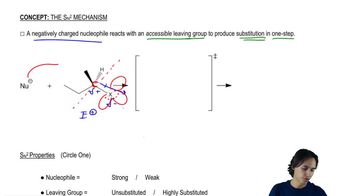
The SN2 (substitution nucleophilic bimolecular) reaction is a type of nucleophilic substitution where a nucleophile attacks an electrophile, resulting in the simultaneous displacement of a leaving group. This mechanism involves a single concerted step, where the nucleophile approaches the electrophile from the opposite side of the leaving group, leading to inversion of configuration. Understanding this mechanism is crucial for predicting the outcomes of reactions involving alkyl halides like 1-chlorobutane.
Video consigliato:
08:33
Drawing the SN2 Mechanism

Nucleophiles and Electrophiles

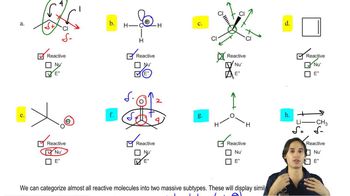
In organic chemistry, nucleophiles are species that donate an electron pair to form a chemical bond, while electrophiles are electron-deficient species that accept electron pairs. In the context of SN2 reactions, the nucleophile attacks the electrophilic carbon atom of the alkyl halide, displacing the leaving group. Identifying strong nucleophiles, such as iodide ions (I-) or cyanide ions (CN-), is essential for successfully converting 1-chlorobutane into the desired products.
Video consigliato:
03:
Nucleophile or Electrophile

Leaving Groups

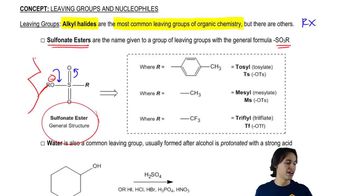
A leaving group is an atom or group that can depart from the parent molecule during a chemical reaction, facilitating the formation of new bonds. In SN2 reactions, the quality of the leaving group significantly affects the reaction rate; better leaving groups, such as iodide (I-) compared to chloride (Cl-), enhance the reaction's efficiency. Understanding the role of leaving groups is vital for predicting the feasibility of converting 1-chlorobutane into 1-iodobutane and butanenitrile.
Video consigliato:
07:22
The 3 important leaving groups to know.