


Ch.6 - Alkyl Halides; Nucleophilic Substitution
Wade - Organic Chemistry 9th Edition
Wade9th EditionOrganic ChemistryISBN: 9780135213728Non è quello che usi tu?Cambia libro di testo
Capitolo 6, Problema 9b

The light-initiated reaction of 2,3-dimethylbut-2-ene with N-bromosuccinimide (NBS) gives two products:

b. The bromination of cyclohexene using NBS gives only one major product, as shown on the previous page. Explain why there is no second product from an allylic shift.

Guida verificata passo dopo passo
1
Step 1: Understand the reaction mechanism. The reaction involves the allylic bromination of cyclohexene using N-bromosuccinimide (NBS) under light (hv). NBS is a source of bromine radicals, which selectively react at the allylic position of alkenes.
Step 2: Identify the allylic positions in cyclohexene. The allylic position is the carbon atom adjacent to the double bond. In cyclohexene, there are two equivalent allylic positions due to the symmetry of the molecule.
Step 3: Explain the formation of the major product. The bromine radical reacts with one of the allylic hydrogens, forming a resonance-stabilized allylic radical. This radical is symmetric, meaning the bromine can attach to either side of the allylic radical, but due to symmetry, only one product is formed.
Step 4: Address why no second product is formed. In cyclohexene, the allylic radical formed is symmetric, and there is no possibility for an allylic shift to create a different resonance structure that would lead to a second product. This symmetry ensures that only one major product is formed.
Step 5: Conclude the reasoning. The lack of a second product is due to the structural symmetry of cyclohexene, which prevents the formation of distinct allylic radicals or resonance structures that could lead to additional products.

Risposta video verificata per un problema simile:

Questa soluzione video è stata consigliata dai nostri tutor come utile per risolvere questo problema.
Durata del video:
9m

Concetti chiave

Ecco i concetti essenziali che devi comprendere per rispondere correttamente alla domanda.

Bromination Mechanism

Bromination of alkenes typically involves the addition of bromine across the double bond. In the presence of N-bromosuccinimide (NBS) and light, the reaction proceeds via a radical mechanism, where the bromine radical adds to the double bond, forming a brominated product. This mechanism is crucial for understanding how the reaction proceeds and why certain products are favored.
Video consigliato:
00:54
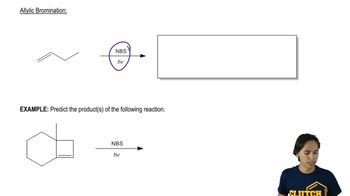
Mechanism of Allylic Bromination.

Allylic Rearrangement

Allylic rearrangement refers to the migration of a substituent from an allylic position (adjacent to a double bond) to a more stable position, often resulting in different product distributions. In the case of cyclohexene, the structure does not allow for a stable allylic radical to form after bromination, which limits the possibility of rearrangement and results in a single major product.
Video consigliato:
06:08
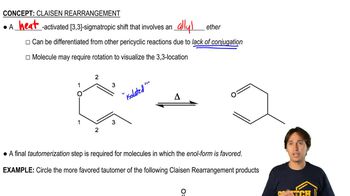
Definition of Claisen Rearrangement

Stability of Radicals

The stability of radicals plays a significant role in determining the products of radical reactions. Tertiary radicals are more stable than secondary or primary radicals due to hyperconjugation and inductive effects. In the case of cyclohexene, the formation of a secondary radical during bromination does not lead to a more stable tertiary radical, thus preventing the formation of a second product from an allylic shift.
Video consigliato:
03:43
The radical stability trend.