


Ch.6 - Alkyl Halides; Nucleophilic Substitution
Wade - Organic Chemistry 9th Edition
Wade9th EditionOrganic ChemistryISBN: 9780135213728Non è quello che usi tu?Cambia libro di testo
Capitolo 6, Problema 9a

The light-initiated reaction of 2,3-dimethylbut-2-ene with N-bromosuccinimide (NBS) gives two products:

a. Give a mechanism for this reaction, showing how the two products arise as a ­consequence of the resonance-stabilized intermediate.

Guida verificata passo dopo passo
1
Step 1: The reaction begins with the homolytic cleavage of the N-Bromosuccinimide (NBS) bond under light (hv) conditions, generating a bromine radical (Br•). This radical is highly reactive and initiates the reaction.
Step 2: The bromine radical abstracts a hydrogen atom from one of the allylic positions of 2,3-dimethylbut-2-ene, forming an allylic radical. The allylic radical is resonance-stabilized, meaning the unpaired electron can delocalize over the π-system of the double bond.
Step 3: Write out the resonance structures of the allylic radical. The delocalization of the unpaired electron allows for two possible positions where the bromine atom can attach, leading to the formation of two distinct products.
Step 4: The bromine radical reacts with the allylic radical at either of the resonance-stabilized positions, forming two products: one where bromine is attached to the primary allylic position and another where bromine is attached to the secondary allylic position.
Step 5: The final products are 3-bromo-2,3-dimethylbut-1-ene and 1-bromo-2,3-dimethylbut-2-ene. These products arise due to the resonance stabilization of the intermediate allylic radical, which allows for regioselectivity in the bromination process.

Risposta video verificata per un problema simile:

Questa soluzione video è stata consigliata dai nostri tutor come utile per risolvere questo problema.
Durata del video:
12m

Concetti chiave

Ecco i concetti essenziali che devi comprendere per rispondere correttamente alla domanda.

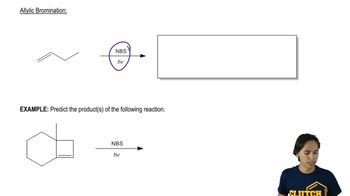
Allylic Bromination

Allylic bromination is a reaction where bromine is added to the allylic position of an alkene, which is the carbon adjacent to a double bond. This reaction typically involves the use of N-bromosuccinimide (NBS) and is initiated by light (hv). The process generates a resonance-stabilized radical intermediate, allowing for the formation of multiple products due to the different possible sites for bromination.
Video consigliato:
00:54
Mechanism of Allylic Bromination.

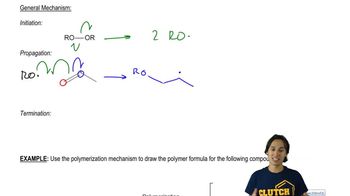
Radical Mechanism

The radical mechanism involves the formation of free radicals, which are highly reactive species with unpaired electrons. In the case of allylic bromination, the reaction begins with the homolytic cleavage of the N-Br bond in NBS, generating bromine radicals. These radicals then abstract a hydrogen atom from the allylic position of the alkene, forming a resonance-stabilized radical that can lead to different brominated products depending on where the bromine adds.
Video consigliato:
03:28
The mechanism of Radical Polymerization.

Resonance Stabilization

Resonance stabilization refers to the delocalization of electrons in a molecule, which can lower its energy and increase stability. In the context of the reaction, the allylic radical formed after hydrogen abstraction can be represented by multiple resonance structures. This delocalization allows the radical to be stabilized over multiple carbon atoms, making it more favorable for bromination to occur at different positions, resulting in the formation of two distinct products.
Video consigliato:
03:43
The radical stability trend.