
Ch.6 - Alkyl Halides; Nucleophilic Substitution
Wade - Organic Chemistry 9th Edition
Wade9th EditionOrganic ChemistryISBN: 9780135213728Non è quello che usi tu?Cambia libro di testo
Capitolo 6, Problema 6

The reaction of an amine with an alkyl halide gives an ammonium salt. R3N amine + R'—X alkyl halide —> R3(N+)—R' X- ammonium salt The rate of this SN2 reaction is sensitive to the polarity of the solvent. 1. Draw an energy diagram for this reaction in a nonpolar solvent and another in a polar solvent. 2. Consider the nature of the transition state, and explain why this reaction should be sensitive to the polarity of the solvent. 3. Predict whether it will be faster or slower in a more polar solvent.

Guida verificata passo dopo passo
1
Identify the key components of the reaction: the amine (R3N), the alkyl halide (R'—X), and the resulting ammonium salt (R3(N+)—R' X-).
Understand that the reaction proceeds via an SN2 mechanism, which involves a single transition state where the nucleophile attacks the electrophile, leading to the inversion of configuration.
Draw the energy diagram for the reaction in a nonpolar solvent: Start with the reactants at a certain energy level, show a single peak representing the transition state, and end with the products at a lower energy level.
Draw the energy diagram for the reaction in a polar solvent: The transition state will be stabilized by the polar solvent, resulting in a lower energy peak compared to the nonpolar solvent diagram.
Explain that the reaction is faster in a polar solvent because the polar solvent stabilizes the transition state, lowering the activation energy and increasing the reaction rate.

Risposta video verificata per un problema simile:

Questa soluzione video è stata consigliata dai nostri tutor come utile per risolvere questo problema.
Durata del video:
8m

Concetti chiave

Ecco i concetti essenziali che devi comprendere per rispondere correttamente alla domanda.

SN2 Reaction Mechanism

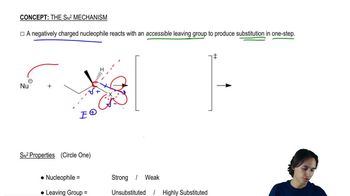
The SN2 (substitution nucleophilic bimolecular) reaction mechanism involves a single concerted step where the nucleophile attacks the electrophile, leading to the simultaneous displacement of the leaving group. This mechanism is characterized by a transition state where both the nucleophile and the leaving group are partially bonded to the carbon atom. The reaction rate depends on the concentration of both the nucleophile and the substrate, making it sensitive to steric hindrance and solvent effects.
Video consigliato:
08:33
Drawing the SN2 Mechanism

Transition State Theory

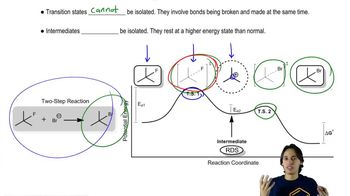
Transition state theory describes the high-energy state that occurs during a chemical reaction, where reactants are transformed into products. The transition state is a critical point along the reaction coordinate, representing the highest energy barrier that must be overcome for the reaction to proceed. The nature of the transition state can be influenced by solvent polarity, as polar solvents can stabilize charged transition states, thereby affecting the reaction rate.
Video consigliato:
06:55
Intermediates vs. Transition States

Solvent Polarity and Reaction Rate

The polarity of a solvent affects the stability of ions and transition states in a reaction. In polar solvents, ionic species are better stabilized due to solvation effects, which can lower the activation energy for reactions involving charged transition states. For the SN2 reaction described, a more polar solvent would stabilize the transition state, potentially leading to a faster reaction rate compared to a nonpolar solvent, where the transition state may be less stabilized.
Video consigliato:
Percorso guidato
5:07
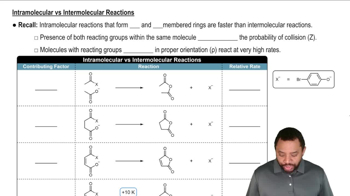
Rates of Intramolecular Reactions Concept 2
Pratica correlata
Domanda del libro di testo

a. Propose a mechanism for the following reaction:

b. Use the bond-dissociation enthalpies given in Table 4-2 (page 167) to calculate the value of ΔH° for each step shown in your mechanism. (The BDE for CH2=CHCH2―Br is about 280 kJ/mol, or 67 kcal/mol.) Calculate the overall value of ΔH° for the reaction. Are these values consistent with a rapid free-radical chain reaction?

2163
views
Domanda del libro di testo

For each pair of compounds, predict which one has the higher molecular dipole moment, and explain your reasoning.

c. cis-2,3-dibromobut-2-ene or trans-2,3-dibromobut-2-ene

d. cis-1,2-dichlorocyclobutane or trans-1,3-dichlorocyclobutane

1395
views
Domanda del libro di testo
The reaction of an amine with an alkyl halide gives an ammonium salt. R3N amine + R'—X alkyl halide —> R3(N+)—R' X- ammonium salt The rate of this SN2 reaction is sensitive to the polarity of the solvent. 1. Draw an energy diagram for this reaction in a nonpolar solvent and another in a polar solvent. 2. Consider the nature of the transition state, and explain why this reaction should be sensitive to the polarity of the solvent. 3. Predict whether it will be faster or slower in a more polar solvent.

2761
views
Domanda del libro di testo

Kepone, aldrin, and chlordane are synthesized from hexachlorocyclopentadiene and other five-membered-ring compounds. Show how these three pesticides are composed of two five-membered rings.

980
views
Domanda del libro di testo

For each pair of compounds, predict which one has the higher molecular dipole moment, and explain your reasoning.

a. ethyl chloride or ethyl iodide

b. 1-bromopropane or cyclopropane

1684
views
Domanda del libro di testo

Under appropriate conditions, (S)-1-bromo-1-fluoroethane reacts with sodium methoxide to give pure (S)-1-fluoro-1-methoxyethane.

a. Why is bromide rather than fluoride replaced?

b. Draw perspective structures (as shown on the previous page for 2-bromobutane) for the starting material, the transition state, and the product.

c. Does the product show retention or inversion of configuration? d. Is this result consistent with reaction by the SN2 mechanism?

2378
views