Skip to main content
Personal Health
Il mio corso
Impara
Preparazione agli esami
AI Tutor
Guide di studio
Flashcard
Prova l'app
Il mio corso
Impara
Preparazione agli esami
AI Tutor
Guide di studio
Flashcard
Prova l'app
Indietro
Types of Cancers definitions
Puoi toccare per girare la carta.
Carcinoma
Puoi toccare per girare la carta.
👆
Carcinoma
Originates in epithelial cells covering body surfaces; forms solid tumors in organs like skin, lungs, and prostate.
Avanzamenti del tracciato
I pulsanti di controllo sono stati cambiati in modalità "navigazione".
1/15
Flashcard correlate
Pratica correlata
Video consigliati
Types of Cancers quiz
Types of Cancers
20 Termini
Types of Cancers
Ch.10 Major Diseases
5 Problemi
Argomento
Ally
Intro to Diabetes
Ch.10 Major Diseases
4 Problemi
Argomento
Laura
Ch.10 Major Diseases - Part 1 of 2
4 Argomenti
9 Problemi
Capitolo
Brendan
Ch.10 Major Diseases - Part 2 of 2
3 Argomenti
8 Problemi
Capitolo
Nicole
VideoThumbView.guidedCourse
00:58
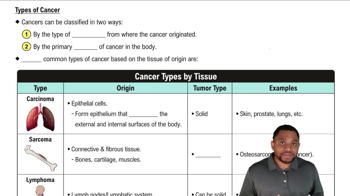
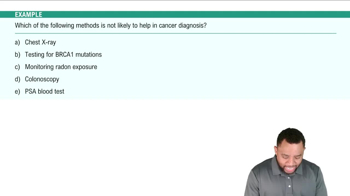
Types of Cancer Example 1
45
views
VideoThumbView.guidedCourse
2:31
Types of Cancer Concept 1
55
views
VideoThumbView.guidedCourse
1:03
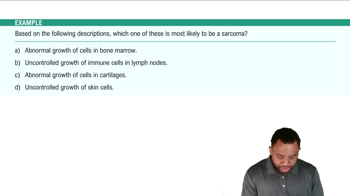
Types of Cancer by Primary Tumor Site Example 2
47
views
Termini in questo insieme (15)
Nascondere definizioni
Carcinoma
Originates in epithelial cells covering body surfaces; forms solid tumors in organs like skin, lungs, and prostate.
Sarcoma
Arises from connective or fibrous tissue such as bone, cartilage, or muscle; typically forms solid tumors.
Lymphoma
Develops in lymphatic system tissues, especially lymph nodes; can present as solid tumors like Hodgkin's type.
Leukemia
Affects blood-forming tissues including bone marrow and spleen; characterized by non-solid tumors and abnormal blood cells.
Epithelial Cells
Cells forming the outer and inner surfaces of the body, serving as the origin for certain cancer types.
Connective Tissue
Structural tissue such as bone, cartilage, and muscle, where specific cancers like sarcoma originate.
Lymphatic System
Network of tissues and organs including lymph nodes, crucial for immune function and a site for lymphoma development.
Bone Marrow
Spongy tissue inside bones responsible for blood cell production; commonly affected in leukemia.
Primary Site
Initial location in the body where a tumor develops, often used to name and classify cancers.
Risk Factors
Characteristics or exposures, such as smoking or genetics, that increase the likelihood of developing cancer.
Screenings
Medical tests like mammograms or colonoscopies used for early detection of cancer before symptoms appear.
Chemotherapy
Treatment using drugs to destroy cancer cells, often combined with surgery or radiation for better outcomes.
Radiation
Therapeutic use of high-energy rays to target and kill cancer cells, frequently used after surgery.
Tumor
Abnormal mass of tissue resulting from uncontrolled cell growth, which may be solid or non-solid depending on cancer type.
Carcinogen
Substance or exposure, such as tobacco smoke or alcohol, known to increase cancer risk by causing cellular changes.
 IndietroIndietro



 00:58
00:58