Skip to main content
Physics with Calculus
Il mio corso
Impara
Preparazione agli esami
AI Tutor
Guide di studio
Soluzioni per libri di testo
Flashcard
Esplora
Prova l'app
Il mio corso
Impara
Preparazione agli esami
AI Tutor
Guide di studio
Soluzioni per libri di testo
Flashcard
Esplora
Prova l'app
Indietro
Intro to Motion in 2D: Position & Displacement definitions
Puoi toccare per girare la carta.
Two-dimensional motion
Puoi toccare per girare la carta.
👆
Two-dimensional motion
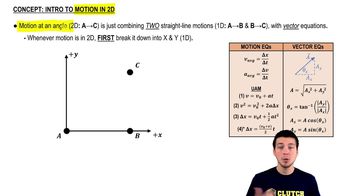
Movement in a plane involving both X and Y axes, often represented through vector equations.
Avanzamenti del tracciato
I pulsanti di controllo sono stati cambiati in modalità "navigazione".
1/15
Flashcard correlate
Pratica correlata
Video consigliati
Intro to Motion in 2D: Position & Displacement quiz
Intro to Motion in 2D: Position & Displacement
13 Termini
Intro to Motion in 2D: Position & Displacement quiz #1
Intro to Motion in 2D: Position & Displacement
14 Termini
Intro to Motion in 2D: Position & Displacement
4. 2D Kinematics
5 Problemi
Argomento
Patrick
Velocity in 2D
4. 2D Kinematics
5 Problemi
Argomento
Catherine
4. 2D Kinematics - Part 1 of 2
5 Argomenti
12 Problemi
Capitolo
Patrick
4. 2D Kinematics - Part 2 of 2
2 Argomenti
6 Problemi
Capitolo
VideoThumbView.guidedCourse
07:07
Final Position Vector
10893
views
245
rank
9
comments
VideoThumbView.guidedCourse
01:39
Intro to Motion in 2D
17719
views
332
rank
VideoThumbView.guidedCourse
06:30
Position and Displacement in 2D
14476
views
278
rank
Termini in questo insieme (15)
Nascondere definizioni
Two-dimensional motion
Movement in a plane involving both X and Y axes, often represented through vector equations.
Position vector
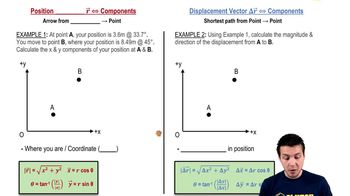
A vector pointing from the origin to a specific point, represented as r with components X and Y.
Displacement
The shortest path between two points, represented as a vector with X and Y components.
Vector
A quantity with both magnitude and direction, used to represent position and displacement.
Components
The X and Y parts of a vector, calculated using trigonometric functions like cosine and sine.
Magnitude
The length of a vector, calculated using the Pythagorean theorem for displacement.
Direction
The angle of a vector, determined using the tangent inverse of the Y component over the X component.
Pythagorean theorem
A formula to calculate the magnitude of a vector: square root of X squared plus Y squared.
Tangent inverse
A trigonometric function used to find the angle of a vector from its components.
Trigonometric functions
Functions like cosine and sine used to decompose vectors into X and Y components.
Coordinate
A pair of values (X, Y) representing a point's position in a two-dimensional plane.
Origin
The starting point (0,0) in a coordinate system from which vectors are measured.
Triangle
A geometric shape used to break down vectors into components in two-dimensional motion.
Delta
A symbol representing change, used in vectors to denote displacement.
Angle
The measure of rotation needed to align one vector with another, often found using trigonometry.
 IndietroIndietro

 07:07
07:07