Skip to main content
Physics with Calculus
Il mio corso
Impara
Preparazione agli esami
AI Tutor
Guide di studio
Soluzioni per libri di testo
Flashcard
Esplora
Prova l'app
Il mio corso
Impara
Preparazione agli esami
AI Tutor
Guide di studio
Soluzioni per libri di testo
Flashcard
Esplora
Prova l'app
Indietro
Intro to Current definitions
Puoi toccare per girare la carta.
Electrodynamics
Puoi toccare per girare la carta.
👆
Electrodynamics
Study of electric charges in motion, as opposed to electrostatics where charges are stationary.
Avanzamenti del tracciato
I pulsanti di controllo sono stati cambiati in modalità "navigazione".
1/12
Flashcard correlate
Pratica correlata
Video consigliati
Intro to Current quiz
Intro to Current
11 Termini
Intro to Current quiz #1
Intro to Current
40 Termini
Intro to Current
27. Resistors & DC Circuits
7 Problemi
Argomento
Patrick
Current with Calculus
27. Resistors & DC Circuits
5 Problemi
Argomento
27. Resistors & DC Circuits - Part 1 of 2
4 Argomenti
12 Problemi
Capitolo
Patrick
27. Resistors & DC Circuits - Part 2 of 2
5 Argomenti
14 Problemi
Capitolo
Patrick
VideoThumbView.guidedCourse
05:38
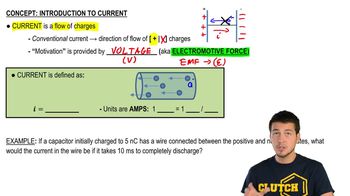
Intro to Current
15371
views
354
rank
5
comments
Termini in questo insieme (12)
Nascondere definizioni
Electrodynamics
Study of electric charges in motion, as opposed to electrostatics where charges are stationary.
Current
Flow of electric charge, typically measured in amperes, representing charge passing through a point per unit time.
Conventional Current
Direction of current flow assumed to be positive charges, opposite to the actual electron flow.
Potential Difference
Voltage between two points that motivates charge movement, also known as electromotive force.
Electromotive Force
Another term for potential difference, not an actual force, but drives electron movement.
Amperes
Unit of electric current, equivalent to one coulomb of charge passing a point per second.
Capacitor
Device that stores electrical energy in an electric field, used in the example to calculate current.
Nano Coulombs
Unit of electric charge, equal to 10^-9 coulombs, used in the example calculation.
Milliamp
One thousandth of an ampere, used to measure small currents in the example.
Elementary Charge
Fundamental charge unit, approximately 1.6 x 10^-19 coulombs, used to calculate electron numbers.
Cross-sectional Area
Area through which charge flows, used to define current as charge per time.
Electron Flow
Actual movement of electrons, opposite to the direction of conventional current.
 IndietroIndietro
 05:38
05:38