Skip to main content
Physics with Calculus
Il mio corso
Impara
Preparazione agli esami
AI Tutor
Guide di studio
Soluzioni per libri di testo
Flashcard
Esplora
Prova l'app
Il mio corso
Impara
Preparazione agli esami
AI Tutor
Guide di studio
Soluzioni per libri di testo
Flashcard
Esplora
Prova l'app
Indietro
Negative (Downward) Launch quiz
Puoi toccare per girare la carta.
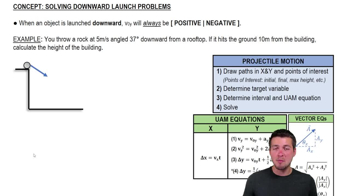
When an object is launched downward, what is always true about its initial velocity in the y-direction?
Puoi toccare per girare la carta.
👆
When an object is launched downward, what is always true about its initial velocity in the y-direction?
The initial velocity in the y-direction (V_{Ay}) is always negative because downward is defined as the negative direction.
Avanzamenti del tracciato
I pulsanti di controllo sono stati cambiati in modalità "navigazione".
1/15
Flashcard correlate
Pratica correlata
Video consigliati
Negative (Downward) Launch definitions
Negative (Downward) Launch
15 Termini
Negative (Downward) Launch
5. Projectile Motion
2 Problemi
Argomento
Emilee
Symmetrical Launch
5. Projectile Motion
3 Problemi
Argomento
5. Projectile Motion
6 Argomenti
14 Problemi
Capitolo
Patrick
VideoThumbView.guidedCourse
07:51
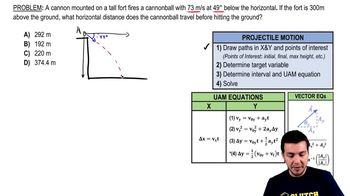
Cannon Firing Downward
6856
views
98
rank
7
comments
VideoThumbView.guidedCourse
08:03
Solving Downward Launch Problems
10955
views
104
rank
6
comments
Termini in questo insieme (15)
Nascondere definizioni
When an object is launched downward, what is always true about its initial velocity in the y-direction?
The initial velocity in the y-direction (V_{Ay}) is always negative because downward is defined as the negative direction.
What is the first step in solving a downward launch projectile motion problem?
The first step is to draw the scenario, labeling the path and points of interest such as the launch point and where the object lands.
How do you determine the height of the building in a downward launch problem?
The height of the building is the absolute value of the vertical displacement (|Δy|) from the launch point to the ground.
What trigonometric function is used to find the initial velocity component in the y-direction?
The sine function is used: V_{Ay} = V_A * sin(θ), where θ is the angle below the horizontal.
How do you calculate the initial velocity component in the x-direction for a downward launch?
Use the cosine function: V_{Ax} = V_A * cos(θ), with θ as the angle below the horizontal.
If you get stuck solving for a variable in one axis, what should you do?
Switch to the other axis and use its equations to solve for additional variables, such as time.
What equation relates horizontal displacement, velocity, and time in projectile motion?
Δx = V_{Ax} * Δt, where Δx is horizontal displacement, V_{Ax} is horizontal velocity, and Δt is time.
Why is the acceleration in the y-direction negative in these problems?
Because acceleration due to gravity acts downward, it is assigned a value of -9.8 m/s².
Which kinematic equation is used when the final velocity is unknown?
The equation Δy = V_{Ay} * Δt + (1/2) * a_y * (Δt)^2 is used when the final velocity is not known.
How do you find the time the object spends in the air using horizontal motion?
Divide the horizontal distance by the horizontal velocity: Δt = Δx / V_{Ax}.
What is the calculated time of flight for a rock thrown downward at 5 m/s at 37° below horizontal, landing 10 m away?
The time of flight is 2.5 seconds.
What is the calculated vertical displacement (Δy) for the example problem in the video?
The vertical displacement is -38.1 meters.
Why do we take the absolute value of vertical displacement to find the building's height?
Because height is always a positive quantity, so we use |Δy|.
How do you calculate the magnitude of the velocity just before the object hits the ground?
Use the Pythagorean theorem: v = sqrt(V_{Bx}^2 + V_{By}^2).
How is the direction of the velocity before impact expressed, and what does a negative angle indicate?
The direction is found using the inverse tangent function, and a negative angle indicates the direction is below the x-axis.
 IndietroIndietro

 07:51
07:51