Skip to main content
Physics with Calculus
Il mio corso
Impara
Preparazione agli esami
AI Tutor
Guide di studio
Soluzioni per libri di testo
Flashcard
Esplora
Prova l'app
Il mio corso
Impara
Preparazione agli esami
AI Tutor
Guide di studio
Soluzioni per libri di testo
Flashcard
Esplora
Prova l'app
Indietro
Operations with Significant Figures quiz
Puoi toccare per girare la carta.
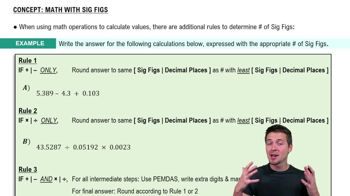
What rule do you use when performing addition or subtraction with significant figures?
Puoi toccare per girare la carta.
👆
What rule do you use when performing addition or subtraction with significant figures?
Round the final answer to the same number of decimal places as the number with the least decimal places in the calculation.
Avanzamenti del tracciato
I pulsanti di controllo sono stati cambiati in modalità "navigazione".
1/15
Flashcard correlate
Pratica correlata
Video consigliati
Operations with Significant Figures definitions
Operations with Significant Figures
15 Termini
Operations with Significant Figures
1. Intro to Physics Units
4 Problemi
Argomento
Patrick
Counting Significant Figures
1. Intro to Physics Units
4 Problemi
Argomento
Patrick
1. Intro to Physics Units
6 Argomenti
14 Problemi
Capitolo
Patrick
VideoThumbView.guidedCourse
03:49
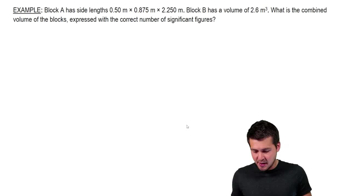
Volume of Two Blocks
6942
views
211
rank
7
comments
VideoThumbView.guidedCourse
08:22
Operations with Significant Figures
11006
views
179
rank
6
comments
Termini in questo insieme (15)
Nascondere definizioni
What rule do you use when performing addition or subtraction with significant figures?
Round the final answer to the same number of decimal places as the number with the least decimal places in the calculation.
How do you determine the number of significant figures in the result of multiplication or division?
Round the final answer to the same number of significant figures as the number with the least significant figures used in the calculation.
What should you do when a calculation involves both addition/subtraction and multiplication/division?
Follow the order of operations and round the final answer based on the operation performed last.
When entering calculations into a calculator, what is the recommended method?
Input calculations exactly as seen, moving from left to right, to avoid errors in the final result.
What is the rule for rounding when the digit immediately after the rounding place is five or more?
Round up the last retained digit if the next digit is five or more.
Why are significant figure rules important in scientific and engineering contexts?
They maintain the precision of calculated results and ensure accuracy in reporting measurements.
In addition and subtraction, what aspect of the numbers determines how you round the answer?
The number with the least decimal places determines how you round the answer.
How do you count significant figures in a number with leading zeros?
Ignore leading zeros and count all remaining digits as significant figures.
If you have numbers with 2 and 4 decimal places in an addition, to how many decimal places do you round the answer?
Round the answer to 2 decimal places, the least among the numbers.
When mixing addition/subtraction with multiplication/division, which operation's rule do you use for rounding?
Use the rule for the operation performed last in the calculation.
What is the correct way to process a calculation with multiple operations to avoid errors?
Always move left to right in your calculator and follow the order of operations.
If the least number of significant figures in a multiplication/division problem is 2, how many significant figures should the answer have?
The answer should have 2 significant figures.
How do you round 8.8501 to two decimal places?
Look at the third digit (0); since it is less than 5, round to 8.85.
What is the process for rounding 1.192 to one decimal place?
Look at the second digit (9); since it is greater than 5, round up to 1.2.
When rounding to a certain number of significant figures, what do you do if the next digit is greater than 5?
Round the last retained digit up by one.
 IndietroIndietro
 03:49
03:49