 Indietro
Current and Resistance - Physics
 05:38
05:38
Termini in questo insieme (20)
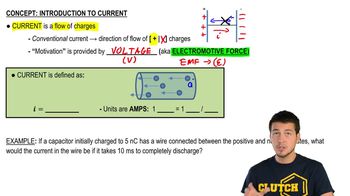
Electric current is the motion of charge through a conductor, such as a wire.
Electrons are the charge carriers in metals, moving to form current.
Conventional current is defined as the flow of positive charge, from higher to lower potential.
The current is the same at all points in a current-carrying wire; current entering a device equals current leaving it.
At a junction, the sum of currents entering equals the sum of currents leaving.
Electric potential difference is the energy per unit charge that drives current through a circuit.
emf is the potential difference established by a device like a battery that actively separates charge, measured in volts.
A battery acts like a charge escalator, lifting charges to a higher potential to sustain current flow.
Current depends on the potential difference and the wire’s properties: length, thickness, and material.
Resistance measures how hard it is to push charges through a wire; higher resistance means lower current for a given voltage.
The ohm (Ω) is the SI unit of resistance, defined as 1 Ω = 1 V/A.
Resistance \(R=\rho \frac{L}{A}\), where ρ is resistivity, L is length, and A is cross-sectional area.
Resistivity is a material property indicating how strongly it opposes current; low resistivity means good conductor.
Ohm’s Law: \(V=IR\), where V is voltage, I is current, and R is resistance.
Ohmic materials have constant resistance and obey Ohm’s Law; nonohmic materials do not.
Resistance of metals increases with temperature due to increased resistivity.
Power \(P=IV\), the rate energy is transferred or dissipated in a circuit.
Power can be written as \(P=I^2R=\frac{V^2}{R}\).
The current increases by a factor of 8, since current depends on cross-sectional area and drift velocity.
Because current is conserved, identical bulbs in series carry the same current and thus have equal brightness.