 Indietro
Forces and Newton's Laws of Motion - Chapter 4
 04:46
04:46
Termini in questo insieme (20)
A force is any interaction that changes an object's velocity. It is a push or a pull and is a vector quantity with magnitude and direction.
Forces are either contact forces (require physical contact) or long-range forces (act through empty space).
Tension is a pulling force transmitted through a string, cable, or rope, always directed along the string toward the agent pulling it.
Friction opposes motion or potential motion. Types include static friction (no motion) and kinetic friction (motion), plus drag and viscosity in fluids.
The normal force is a contact force perpendicular to the surface, acting as a reaction force when an object pushes on a surface.
Thrust is a pushing force that propels objects like cars, airplanes, or rockets forward, usually given rather than calculated.
Attractive forces pull objects together (e.g., gravity), while repulsive forces push objects apart (e.g., some magnetic forces).
Inertia is the tendency of matter to remain at rest or in constant velocity unless acted upon by a force. Mass measures inertia.
Weight is the force of gravity on an object, calculated as \(F_g = mg\), where g is gravitational acceleration.
No. Mass is a scalar measure of inertia and is constant, while weight is a vector force that depends on location and gravity.
An FBD represents an object as a point with all forces acting on it shown as vectors starting from that point, labeled clearly.
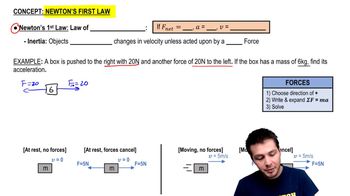
In the absence of a net force, an object at rest stays at rest, and an object in motion continues with constant velocity: \(\vec{F}_{net} = 0 \Rightarrow \vec{a} = 0\).
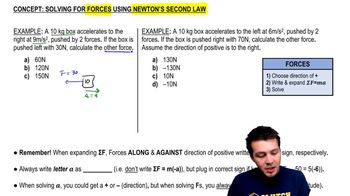
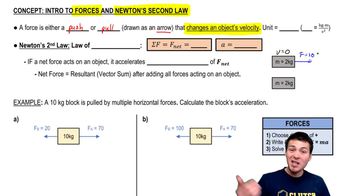
The acceleration of an object is proportional to the net force and inversely proportional to its mass: \(\vec{F}_{net} = m\vec{a}\).
Doubling the force doubles acceleration; doubling the mass halves acceleration; force and acceleration vectors have the same direction.
For every action force, there is an equal and opposite reaction force: \(\vec{F}_{1\to2} = -\vec{F}_{2\to1}\). These forces act on different objects.
No, because they act on different objects, so they do not cancel in a single object's free-body diagram.
Add all forces vectorially: \(\vec{F}_{net} = \sum \vec{F}_i\).
It simplifies analysis by treating an object's mass as concentrated at a single point where all forces act, ignoring shape and size.
Internal forces occur in action-reaction pairs and cancel out when considering the system as a whole, affecting only interactions within the system.
If objects are in contact and move together, they share the same acceleration: \(\vec{a}_1 = \vec{a}_2 = \cdots = \vec{a}\).