 Indietro
Momentum and Impulse in Physics with Calculus
 05:17
05:17
Termini in questo insieme (23)
Inertia in motion.
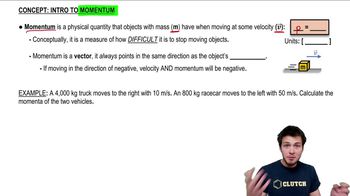
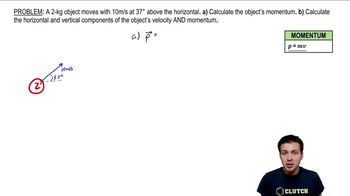
Momentum is the object’s mass times its velocity.
Kg·m/s (kilogram meters per second) or N·s (Newton-seconds).
If the heavy truck has a smaller velocity than the light automobile.
The skateboard is moving much faster than the car.
Momentum is a vector, with both magnitude and direction.
The change in an object’s momentum during a time interval equals the net force times the duration of that interval.
Airbags decrease the force on the driver by increasing the time it takes to stop.
When an object bounces.
Newton’s second law.
No net external force is exerted on the system during the process.
During the brief collision, the total momentum of the two players (the system) is conserved.
A collision between two bumper cars.
A ball being caught in a glove.
The law of conservation of momentum.
Their total momentum is zero.
No, an object always has one unique velocity and one unique mass at any given moment.
A change in the object’s mass, velocity, or a force acting on it.
When the skydiver falls at a steady speed with her parachute deployed.
Cars colliding, but not in radioactive decay or stars exploding.
Z does not change in any way during that process.
They might have the same momentum but might not, depending on direction.
Somewhere south of east, but not more specific without calculation.