 Indietro
Newton's First Law and Motion Concepts
 04:46
04:46
Termini in questo insieme (20)
Natural motion is motion toward an object's proper place (e.g., stones fall, smoke rises). Violent motion is caused by external pushes or pulls (e.g., wind moving ships).
Objects fall at the same rate regardless of weight without air resistance. A moving object needs no force to keep moving if friction is absent.
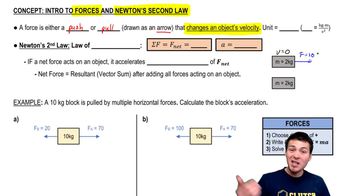
Force is a push or pull. Inertia is a property of matter resisting changes in motion, depending on mass.
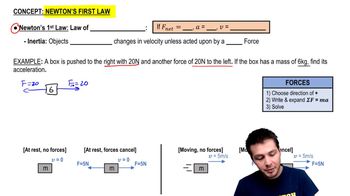
Objects remain at rest or move at constant velocity unless acted on by a nonzero net force.
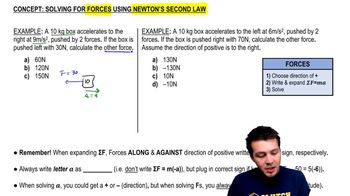
The vector sum of all forces acting on an object, considering magnitude and direction.
Subtract smaller force from larger force; direction is that of the larger force.
A quantity with both magnitude and direction, represented by arrows (e.g., force, velocity).
A quantity with only magnitude, no direction (e.g., mass, volume, speed).
The sum of two or more vectors. Add magnitudes if same direction, subtract if opposite, or use parallelogram rule if at angles.
Used to find resultant of two vectors not aligned; the diagonal of the parallelogram formed by the vectors is the resultant.
The vector sum of forces on a nonaccelerating object is zero: \(\sum F=0\).
An upward force opposing gravity, exerted by surfaces to support objects resting on them.
For every action force, there is an equal and opposite reaction force.
An object at rest with no net force acting on it.
An object moving at constant velocity with no net force acting on it.
The rate of change of velocity over time, including changes in speed or direction.
Velocity units divided by time units, e.g., meters per second squared (m/s²).
When it changes speed (slowing or speeding up) or changes direction (e.g., rounding a curve).
When pushing an object at steady speed, applied force equals friction force.
Motion is described relative to a reference point, e.g., walking on Earth vs. Earth moving around the Sun.