 Indietro
Newton's First Law and Related Concepts
 04:46
04:46
Termini in questo insieme (20)
Natural motion is movement toward an object's proper place (earth, water, air, fire). Violent motion is caused by external pushes or pulls.
Objects in motion stay in motion unless acted on by friction or another force. Inertia is a property of matter resisting changes in motion.
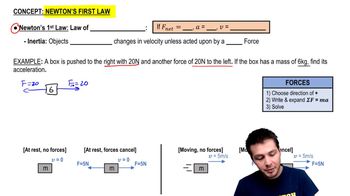
Every object continues in a state of rest or uniform motion in a straight line unless acted on by a nonzero net force.
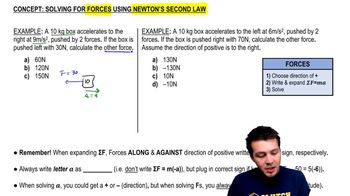
The vector sum of all forces acting on an object, determining its acceleration.
A quantity with both magnitude and direction, represented by arrows.
A quantity with only magnitude, no direction.
The vector sum of two or more vectors, found by arithmetic addition or the parallelogram rule.
The vector sum of forces on a nonaccelerating object equals zero: \(\sum F=0\).
An upward force that balances the force of gravity on an object resting on a surface.
An object at rest with no net force acting on it.
An object moving at constant velocity with no net force acting on it.
When pushing an object at steady speed, the applied force equals the friction force.
A moving object needs no force to keep moving if friction is absent.
Inclined planes helped Galileo discover inertia by reducing acceleration effects.
Subtract smaller force from larger; direction is that of the larger force.
Used to find the resultant of two vectors not aligned in the same or opposite directions.
Tensions differ due to angles; vector sum of tensions balances the weight in equilibrium.
Due to inertia, the coin maintains the vehicle's sideways velocity while moving up and down.
Natural motion is inherent and directed to an object's proper place; violent motion results from external forces.
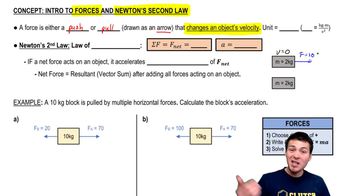
A push or pull that can change an object's motion.