Skip to main content
Physics with Calculus
Il mio corso
Impara
Preparazione agli esami
AI Tutor
Guide di studio
Soluzioni per libri di testo
Flashcard
Esplora
Prova l'app
Il mio corso
Impara
Preparazione agli esami
AI Tutor
Guide di studio
Soluzioni per libri di testo
Flashcard
Esplora
Prova l'app
Indietro
Physics Chapter 23: Electric Charge, Field, Potential, and Energy
Puoi toccare per girare la carta.
What letter(s) represent electric charge?
Puoi toccare per girare la carta.
👆
What letter(s) represent electric charge?
Electric charge is represented by \(q\) or \(Q\).
Avanzamenti del tracciato
I pulsanti di controllo sono stati cambiati in modalità "navigazione".
1/20
Video consigliati
VideoThumbView.guidedCourse
01:06
Charge of Atom
18797
views
538
rank
VideoThumbView.guidedCourse
05:37
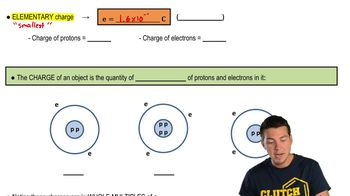
Electric Charge
30159
views
991
rank
4
comments
VideoThumbView.guidedCourse
04:32
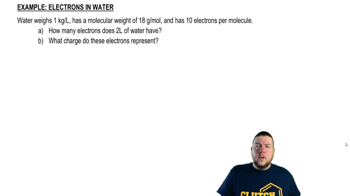
Electrons In Water (Using Density)
15977
views
332
rank
17
comments
Termini in questo insieme (20)
Nascondere definizioni
What letter(s) represent electric charge?
Electric charge is represented by \(q\) or \(Q\).
What is the SI unit of electric charge?
The SI unit of electric charge is the
coulomb (C)
.
What letter represents the electric field?
The electric field is represented by the letter \(E\).
What are the SI units of the electric field?
The electric field is measured in
newtons per coulomb (N/C)
or
volts per meter (V/m)
.
What letter represents work in physics equations?
Work is represented by the letter \(W\).
What is the SI unit of work?
Work is measured in
joules (J)
.
What letter represents electric potential energy?
Electric potential energy is represented by the letter \(U\).
What is the SI unit of electric potential energy?
Electric potential energy is measured in
joules (J)
.
What letter represents electric potential (voltage)?
Electric potential is represented by the letter \(V\).
What is the SI unit of electric potential?
Electric potential is measured in
volts (V)
.
Write the equation relating work done by a conservative force to potential energy.
The work done by a conservative force is related to potential energy by \(W = -\Delta U\).
Write the equation for electric potential energy between two point charges.
Electric potential energy between two point charges is \(U = \frac{1}{4 \pi \epsilon_0} \frac{q_1 q_2}{r}\).
Write the equation for electric potential due to a point charge at point P.
Electric potential at point P due to a point charge is \(V(P) = \frac{1}{4 \pi \epsilon_0} \frac{q}{r}\).
How is the zero of electric potential generally defined for point charges?
The electric potential is defined as zero at infinite distance: \(V_r = 0 \text{ as } r \to \infty\).
How do you calculate the change in electric potential from the electric field?
The change in electric potential is \(\Delta V = V_{final} - V_{initial} = - \int_{l_{initial}}^{l_{final}} \mathbf{E} \cdot d\mathbf{l}\).
How do you find the electric field from the electric potential?
The electric field component is the negative spatial derivative of potential: \(E_x = -\frac{\partial V}{\partial x}\).
What is the vector relation between electric field and electric potential?
The electric field is the negative gradient of the electric potential: \(\mathbf{E} = -\nabla V\).
Write the equation relating change in electric potential energy to change in electric potential.
The change in electric potential energy is \(\Delta U = q \Delta V\).
Write the equation defining kinetic energy of a particle.
Kinetic energy is defined as \(K = \frac{1}{2} m v^2\).
Write the conservation of energy equation introduced in this chapter.
Conservation of energy: \(K_A + U_A = K_B + U_B\) with \(U = qV\).
 IndietroIndietro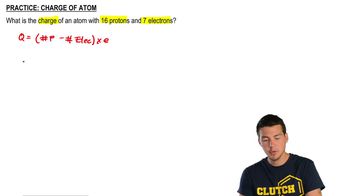
 01:06
01:06