Skip to main content
Physics with Calculus
Il mio corso
Impara
Preparazione agli esami
AI Tutor
Guide di studio
Soluzioni per libri di testo
Flashcard
Esplora
Prova l'app
Il mio corso
Impara
Preparazione agli esami
AI Tutor
Guide di studio
Soluzioni per libri di testo
Flashcard
Esplora
Prova l'app
Indietro
Physics: Momentum, Impulse, and Collisions
Puoi toccare per girare la carta.
Why does a heavier car need more braking force to stop in the same distance as a lighter car at the same speed?
Puoi toccare per girare la carta.
👆
Why does a heavier car need more braking force to stop in the same distance as a lighter car at the same speed?
It has more
momentum
(more mass × same velocity), so more force is needed to remove that momentum over the same distance.
Avanzamenti del tracciato
I pulsanti di controllo sono stati cambiati in modalità "navigazione".
1/20
Video consigliati
VideoThumbView.guidedCourse
05:17
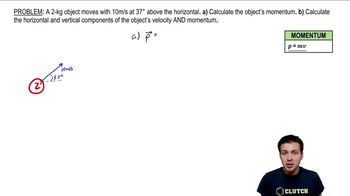
Intro to Momentum
18552
views
535
rank
4
comments
VideoThumbView.guidedCourse
04:15
Momentum in 2D
14129
views
326
rank
5
comments
Termini in questo insieme (20)
Nascondere definizioni
Why does a heavier car need more braking force to stop in the same distance as a lighter car at the same speed?
It has more
momentum
(more mass × same velocity), so more force is needed to remove that momentum over the same distance.
What happens to the required braking force if a car's stopping distance is cut in half?
The braking force must roughly
double
, because the same momentum change must occur in half the distance (less time).
On a frictionless hill, which has greater momentum at the bottom: a truck or a baby carriage?
The
truck
, because it has much greater mass and both reach the same speed.
Do objects of different mass reach the bottom of a frictionless incline at the same speed?
Yes — speed at the bottom depends only on height, not mass.
How does a padded dashboard reduce injury compared to a hard one in a crash?
Padding increases
contact time
, reducing the average force on the passenger for the same impulse.
Between a ball stopped quickly and one stopped slowly, which experiences greater force if impulse is the same?
The ball stopped
quickly
experiences greater force because the same impulse is delivered in less time.
Does a padded dashboard reduce the impulse experienced by a passenger?
No — the impulse (change in momentum) is the same; padding only extends the time over which it acts.
What is the total momentum after two identical balls roll toward each other at the same speed and collide?
Zero — their momenta were equal and opposite before, and momentum is conserved.
What happens to a cannon when it fires a ball forward?
It recoils backward with equal and opposite momentum to the cannonball.
What determines the impulse a car receives when stopping from 30 m/s?
Its mass times its change in velocity (\(\Delta p = m\Delta v\)), regardless of how long it takes.
Is impulse the same as momentum?
No — impulse equals the
change in momentum
(\(\Delta p\)), not the momentum itself (\(p\)).
In a karate chop, how does the force on the hand compare to the force on the cement block?
They are
equal
in magnitude but opposite in direction, according to Newton's third law.
Why does the cement block break but the hand doesn't if the forces are equal?
The block is more brittle and less able to withstand the force; outcome depends on material properties, not force magnitude.
Why does landing on a soft surface feel gentler than landing on a hard one?
The soft surface extends contact time, reducing the average force for the same impulse (momentum change).
Does bouncing quickly off a surface produce a softer or harder landing?
Harder — bouncing reverses momentum, increasing total impulse and requiring more force.
From which law is the impulse-momentum relationship derived?
Newton's
second law
.
What happens to the force involved if you extend the time of a collision?
The force decreases for the same change in momentum.
How is the impulse-momentum theorem expressed mathematically?
\(F\cdot\Delta t = \Delta p = m\Delta v\), connecting force, time, and change in momentum.
Why does a light gun firing a heavy bullet produce strong recoil?
The heavy bullet has large forward momentum; by conservation, the light gun must recoil with equal backward momentum, moving at high speed.
Is momentum conserved when a gun fires a bullet?
Yes — total momentum before (zero) equals total momentum after (bullet forward + gun backward = zero).
 IndietroIndietro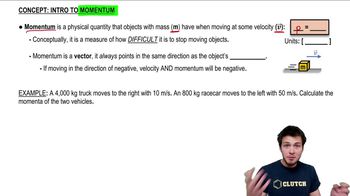
 05:17
05:17