Skip to main content
Physics with Calculus
Il mio corso
Impara
Preparazione agli esami
AI Tutor
Guide di studio
Soluzioni per libri di testo
Flashcard
Esplora
Prova l'app
Il mio corso
Impara
Preparazione agli esami
AI Tutor
Guide di studio
Soluzioni per libri di testo
Flashcard
Esplora
Prova l'app
Indietro
Physics with Calculus - Chapter 2: Motion and Kinematics
Puoi toccare per girare la carta.
What is the difference between distance and displacement?
Puoi toccare per girare la carta.
👆
What is the difference between distance and displacement?
Distance
is the total length of the path traveled, while
displacement
is the straight-line vector from the initial to the final position.
Avanzamenti del tracciato
I pulsanti di controllo sono stati cambiati in modalità "navigazione".
1/20
Video consigliati
VideoThumbView.guidedCourse
06:13
Displacement vs. Distance
21769
views
569
rank
7
comments
VideoThumbView.guidedCourse
04:06
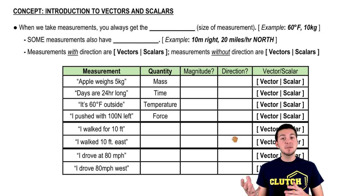
Introduction to Vectors and Scalars
30520
views
1066
rank
1
comments
Termini in questo insieme (20)
Nascondere definizioni
What is the difference between distance and displacement?
Distance
is the total length of the path traveled, while
displacement
is the straight-line vector from the initial to the final position.
How is average velocity defined?
Average velocity is the
displacement
divided by the
time interval
during which the displacement occurred.
What does a motion diagram represent?
A motion diagram shows the positions of an object at successive equal time intervals, illustrating its motion visually.
How can you tell if two blocks have the same speed from their position-time diagrams?
If the blocks cover equal distances in equal time intervals, they have the
same speed
at those intervals.
What does a velocity-time graph show?
A velocity-time graph shows how velocity changes over time; the slope represents
acceleration
.
What is the significance of the slope of a position-time graph?
The slope of a position-time graph at any point is the
instantaneous velocity
at that time.
What is the difference between a secant line and a tangent line on a position-time graph?
A
secant line
connects two points and gives average velocity; a
tangent line
touches one point and gives instantaneous velocity.
What does a flat horizontal line on a velocity-time graph indicate?
A flat horizontal line means the object is moving at a
constant velocity
with zero acceleration.
How is acceleration related to velocity on a velocity-time graph?
Acceleration is the
slope
of the velocity-time graph.
What happens to velocity and acceleration at the peak of a ball tossed in the air?
At the peak,
velocity is zero
but
acceleration is nonzero
due to gravity.
What does a negative slope on a velocity-time graph indicate?
A negative slope indicates
negative acceleration
or deceleration.
How do you interpret motion diagrams with arrows of different lengths?
Arrow length represents speed; longer arrows mean higher speed.
What is instantaneous velocity?
Instantaneous velocity is the velocity of an object at a specific instant, given by the slope of the tangent line on a position-time graph.
How can acceleration be zero while velocity is changing?
Acceleration is zero only if velocity is constant; if velocity changes, acceleration is nonzero.
What does a velocity-time graph look like for constant acceleration?
It is a straight line with a constant slope.
How do you find displacement from a velocity-time graph?
Displacement is the
area under the velocity-time curve
.
What is the difference between speed and velocity?
Speed is a scalar quantity representing magnitude of motion; velocity is a vector including direction.
What does a motion diagram with equally spaced dots indicate?
Equally spaced dots indicate
constant speed
.
How is acceleration related to changes in velocity?
Acceleration is the rate of change of velocity with respect to time.
What does a velocity-time graph with velocity crossing zero indicate?
The object changes direction when velocity crosses zero.
 IndietroIndietro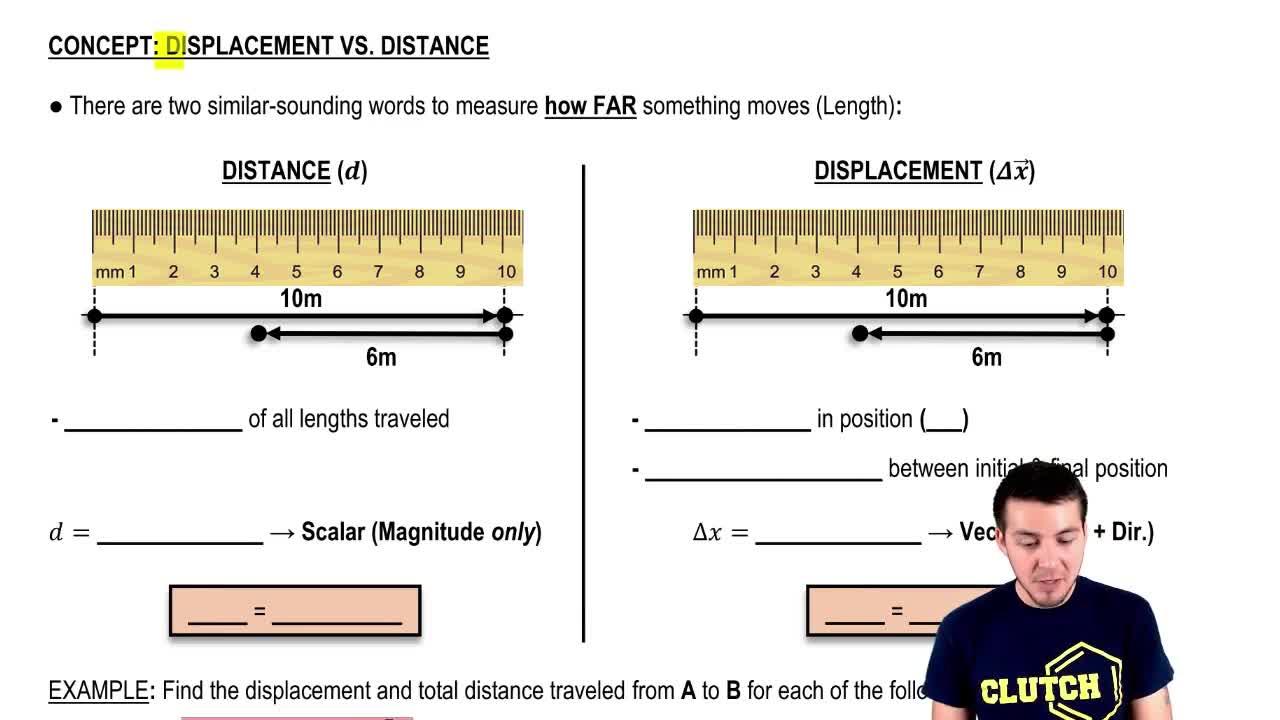
 06:13
06:13