What are the components of a generic vector in 3D space?
A generic vector has three independent components: \(a= a_x \hat{i} + a_y \hat{j} + a_z \hat{k}\).
How is the position vector r(t) defined in 3D motion?
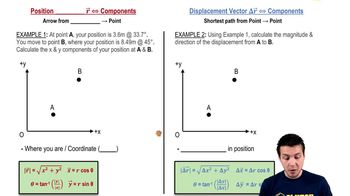
The position vector is \(\vec{r}(t) = x(t) \hat{i} + y(t) \hat{j} + z(t) \hat{k}\), pointing from the origin to the particle's location at time t.
What is the relationship between velocity, acceleration, and the position vector?
Velocity is the time derivative of position: \(\vec{v} = \frac{d\vec{r}}{dt}\), and acceleration is the time derivative of velocity: \(\vec{a} = \frac{d\vec{v}}{dt}\).
What happens when velocity and acceleration vectors do not point in the same direction?
The object changes direction and/or speed; velocity and acceleration are not necessarily aligned.
What are the five simple plane curves often studied in 2D motion?
The five plane curves are: straight line, parabola, hyperbola, circle, and ellipse.
What kind of trajectory does a horizontally fired cannonball follow (ignoring air resistance)?
It follows a parabolic trajectory.
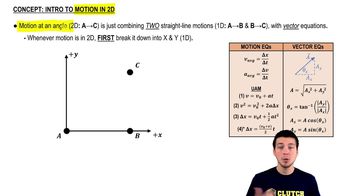
How can 2D motion be treated mathematically?
Motion in the x- and y-directions are independent and can be treated as two separate 1D problems.
What are the kinematic equations for constant acceleration in the x-direction?
\(v_x = a_x t + v_{0x}\), \(x = \frac{1}{2} a_x t^2 + v_{0x} t + x_0\).
What are the kinematic equations for constant acceleration in the y-direction?
\(v_y = a_y t + v_{0y}\), \(y = \frac{1}{2} a_y t^2 + v_{0y} t + y_0\).
In projectile motion without air resistance, what is the acceleration in the x-direction?
The acceleration in the x-direction is zero: \(a_x = 0\).
What is the acceleration in the y-direction for projectile motion near Earth's surface?
The acceleration is due to gravity: \(a_y = -g = -9.8 \text{ m/s}^2\).
How do you decompose the initial velocity of a projectile launched at angle θ?
Which launch angle gives the maximum range for a projectile launched and landing at the same height?
A launch angle of 45 degrees gives the maximum range.
What is the classical formula for adding velocities in different reference frames?
The velocity of A relative to C is the vector sum: \(\vec{v}_{AC} = \vec{v}_{AB} + \vec{v}_{BC}\).
How does relative motion affect observed velocities?
Velocities depend on the observer's frame; the same object can have different velocities relative to different frames.
What is the velocity of the bird relative to the dog if the river flows east at 10 m/s, the dog runs west at 5 m/s, and the bird flies east at 15 m/s relative to the water?
The bird's velocity relative to the dog is 30 m/s east.
How do you find the velocity of one plane relative to another when both have velocities relative to the ground?
Subtract the velocity vectors of the planes relative to the ground to get the relative velocity vector.
What is the significance of the 8 octants in 3D space?
3D space is divided into 8 octants based on the signs of x, y, and z coordinates, analogous to 4 quadrants in 2D.
What is the trajectory described by \(\vec{r}(t) = t \hat{i} + 2t \hat{j} + 3t \hat{k}\)?
It describes a straight line through the origin with direction ratios 1:2:3.
 Indietro
 07:07
07:07