 Indietro
Physics with Calculus: Fundamental Concepts and Newton's Laws
 06:06
06:06
Termini in questo insieme (20)
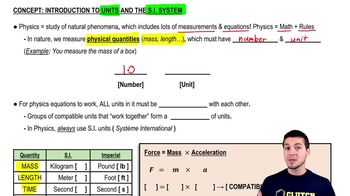
A physical quantity is a property of a physical system that can be measured and expressed with a number and a unit.
A unit is a standard measurement used to express the magnitude of a physical quantity.
A vector has both magnitude and direction, such as displacement, velocity, and force.
A scalar has only magnitude, while a vector has both magnitude and direction.
Motion along a straight line involves displacement, velocity, and acceleration all directed along one dimension.
Displacement is the vector change in position of an object from its initial to final point.
Velocity is the rate of change of displacement with respect to time, a vector quantity.
Acceleration is the rate of change of velocity with respect to time, also a vector.
Motion in 2 or 3 dimensions involves vectors for position, velocity, and acceleration in a plane or space.
Newton's First Law states that an object remains at rest or in uniform motion unless acted upon by a net external force.
Newton's Second Law states that force equals mass times acceleration: \(\mathbf{F} = m\mathbf{a}\).
Newton's Third Law states that for every action, there is an equal and opposite reaction.
Identify forces, draw free-body diagrams, apply \(\mathbf{F} = m\mathbf{a}\), and solve for unknowns.
A free-body diagram shows all forces acting on an object, helping analyze motion and forces.
Acceleration is the time derivative of velocity: \(\mathbf{a} = \frac{d\mathbf{v}}{dt}\).
Velocity is the time derivative of displacement: \(\mathbf{v} = \frac{d\mathbf{x}}{dt}\).
Uniform motion means constant velocity; acceleration is zero.
If net force is zero, the object maintains its current state of motion (Newton's First Law).
Vectors add using the head-to-tail method or component-wise addition.
Mass is a measure of an object's inertia, resisting changes in motion.