Skip to main content
Physics with Calculus
Il mio corso
Impara
Preparazione agli esami
AI Tutor
Guide di studio
Soluzioni per libri di testo
Flashcard
Esplora
Prova l'app
Il mio corso
Impara
Preparazione agli esami
AI Tutor
Guide di studio
Soluzioni per libri di testo
Flashcard
Esplora
Prova l'app
Indietro
Physics with Calculus: Kinematics and Acceleration Concepts
Puoi toccare per girare la carta.
What is acceleration?
Puoi toccare per girare la carta.
👆
What is acceleration?
Acceleration
is the rate of change in velocity.
Avanzamenti del tracciato
I pulsanti di controllo sono stati cambiati in modalità "navigazione".
1/24
Video consigliati
VideoThumbView.guidedCourse
05:47
Intro to Acceleration
20826
views
476
rank
4
comments
Termini in questo insieme (24)
Nascondere definizioni
What is acceleration?
Acceleration
is the rate of change in velocity.
Define distance.
Distance
is how far something travels.
Define speed.
Speed
is how fast an object covers a distance.
Define velocity.
Velocity
is how fast and in what direction an object covers a distance.
What did Galileo say about acceleration on an inclined plane?
The steeper the slope of an inclined plane, the greater the acceleration of the ball.
What is the magnitude of acceleration for a ball falling vertically near Earth's surface?
The magnitude of acceleration is \(9.80\) m/s².
If a car travels east but covers less distance each second, what is the direction of its acceleration?
The acceleration vector points
westward
, opposite to the velocity.
What is true about an object in free fall on Earth?
It accelerates downward at about \(9.8\) m/s², gaining approximately 10 m/s in velocity each second.
What happens to a ball's speed when dropped?
It falls and increases speed at a rate of \(9.8\ m/s^2\) every second.
Is a car traveling at constant speed in a circle accelerating?
Yes, the car is accelerating because its velocity is changing direction.
Which motions are classified as acceleration?
An increase or decrease in velocity, and going around a curve at constant speed.
If you swim across a stream aiming directly across, where do you end up?
You end up downstream from the tree due to the current.
What is the acceleration magnitude at the top of a ball's upward throw?
The acceleration magnitude remains \(9.8\) m/s² downward.
How does the distance fallen during the second second compare to the first second for a dropped ball?
The ball falls farther during the second second than during the first.
What does relative motion mean?
Motion described differently depending on the observer's frame of reference.
What is the velocity of a stone thrown upward at 30 m/s when it returns to your hand?
The velocity is \(-30\ m/s\), equal in magnitude but opposite in direction.
What happens if an object's acceleration vector points in the same direction as its velocity vector?
The object is speeding up.
What is needed to define an object's position in a plane?
The object's distance from a reference point and its angle from a reference line.
What is the velocity of a ball at the top of its ascent when thrown straight up?
The velocity is zero at the top of its ascent.
What is the approximate speed of an object dropped from rest after 3 seconds?
Approximately \(30\ m/s\).
What does the symbol \(g\) represent?
g
is the magnitude of acceleration due to gravity.
What does a car's speedometer measure?
It measures the car's
instantaneous speed
.
How does the distance fallen in the first 3 seconds compare to the next 3 seconds for a dropped ball?
The ball falls farther in the second 3-second interval than in the first.
What happens if an object's acceleration vector points opposite to its velocity vector?
The object is slowing down.
 IndietroIndietro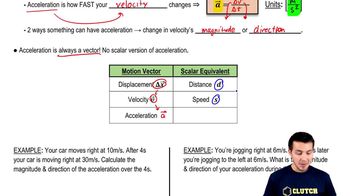
 05:47
05:47