Skip to main content
Physics with Calculus
Il mio corso
Impara
Preparazione agli esami
AI Tutor
Guide di studio
Soluzioni per libri di testo
Flashcard
Esplora
Prova l'app
Il mio corso
Impara
Preparazione agli esami
AI Tutor
Guide di studio
Soluzioni per libri di testo
Flashcard
Esplora
Prova l'app
Indietro
Physics with Calculus: Mechanics and Forces
Puoi toccare per girare la carta.
What defines a vector quantity?
Puoi toccare per girare la carta.
👆
What defines a vector quantity?
A
vector
has both
magnitude
and
direction
. Examples include force, velocity, and acceleration.
Avanzamenti del tracciato
I pulsanti di controllo sono stati cambiati in modalità "navigazione".
1/26
Video consigliati
VideoThumbView.guidedCourse
01:55
Review of Vectors vs. Scalars
17308
views
860
rank
4
comments
Termini in questo insieme (26)
Nascondere definizioni
What defines a vector quantity?
A
vector
has both
magnitude
and
direction
. Examples include force, velocity, and acceleration.
What is a scalar quantity?
A
scalar
has only
magnitude
without direction. Examples include mass, area, and speed.
When is tension in a horizontal cable greatest for a hanging traffic light?
Tension is greatest when the cable
sags very little
, requiring a large horizontal force to balance the vertical weight.
What is the net force on an object in equilibrium?
The net force is
zero
when all forces cancel out, meaning the object is in
equilibrium
.
Why do you lurch left when a bus makes a sudden right turn?
Due to
inertia
, your body resists the change in motion and tries to keep moving forward, making you appear to lurch left.
What did Galileo conclude about a ball rolling on a level surface without friction?
It will
keep rolling indefinitely
if there is no friction to slow it down.
Who first introduced the concept of inertia?
Galileo was the first to introduce the concept of
inertia
through his studies of motion on inclined planes.
How much force is required to maintain a rocket's motion in deep space?
Zero force is required because, without friction, an object continues moving at constant velocity according to Newton's First Law.
Calculate the net force on a crate pushed left with 15 N and right with 5 N.
The net force is
10 N to the left
(15 N left minus 5 N right).
What force keeps Earth moving as it orbits the Sun?
No force is needed to keep Earth moving; gravity provides the centripetal force for orbit, but motion continues by inertia.
What is mechanical equilibrium?
An object is in mechanical equilibrium if the
net force is zero
, meaning it is at rest or moving with constant velocity.
What is the tension in a rope during a tug-of-war with equal 2000 N forces on each side?
The net force is zero, but the rope tension is
2000 N
.
What car safety features help reduce the driver's inertia in an accident?
Seat belts, airbags, and anti-lock brakes help slow the driver's inertia and reduce injury.
What concept explains why a tablecloth can be yanked out from under dishes without moving them?
The concept of
inertia
allows the dishes to resist changes in motion and stay in place.
What is the resultant force of a 30 N force at right angles to a 40 N force?
The resultant force is
50 N
, based on the 3-4-5 right triangle relationship.
What does tension in a rope tend to do?
Tension is a force that tends to
stretch
something.
Define inertia.
Inertia is the tendency of an object to
resist changes
in its motion.
What are the properties of a parallelogram?
A parallelogram has
opposite sides parallel
and
equal in length
.
Where does a clam dropped from a seagull on a moving sailboat land?
It lands
directly below the seagull
on the deck, moving with the boat's velocity.
Why is force considered a vector quantity?
Because force has both
magnitude
and
direction
.
How do tensions in ropes supporting a horizontal scaffold relate to weight?
The tensions add up to equal the
weight of the painter plus the scaffold
.
What is the minimum number of forces acting on a book resting on a table?
Two forces: the book's weight downward and the table's support force upward.
What happens to a rocket in deep space when it runs out of fuel while accelerating?
It stops accelerating but continues at a
constant speed
due to inertia.
On what does the tension in cables holding a traffic light depend?
Tension depends on the
angles of the cables
.
What path does a moving object follow if no forces act on it?
It moves in a
straight line
at constant velocity.
What are possible resultant forces of two 10 N forces acting on a box?
Possible resultants are
0 N
,
20 N
, or about
14 N
depending on the angle.
 IndietroIndietro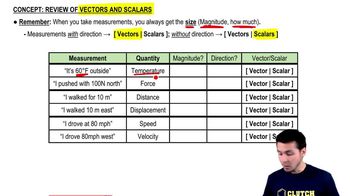
 01:55
01:55