 Indietro
Physics with Calculus: Momentum and Rotational Motion
 05:17
05:17
Termini in questo insieme (21)
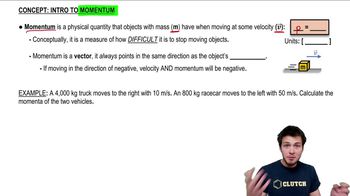
Momentum is the product of an object's mass and its velocity, representing inertia in motion.
Impulse is the product of force and the time interval over which it acts, changing an object's momentum.
Impulse equals the change in momentum: \(Impulse = F \times t = \Delta p\).
The impulse is doubled because impulse is force multiplied by time.
Because the force acts over a longer time, producing a greater impulse and thus greater change in momentum.
Extending the time over which momentum changes reduces the average force, as seen when hitting a haystack instead of a wall.
In the absence of external forces, the total momentum of a system remains constant.
Rotational inertia is an object's resistance to changes in its rotational motion, depending on mass and mass distribution.
The farther the mass is from the axis of rotation, the greater the rotational inertia.
Torque is the tendency of a force to cause rotation, depending on force magnitude, direction, and lever arm.
Torque = Force × lever arm (perpendicular distance from axis to force line).
Center of mass is the average position of mass; center of gravity is the average position of weight distribution, usually the same point.
Suspend the object from two points and draw vertical lines; the intersection is the center of gravity.
If the vertical line from the center of gravity falls inside the base, the object is stable; outside, it is unstable.
A force directed toward the center of a circular path, keeping an object moving in a circle.
\(F_c = \frac{m v^2}{r}\), where m is mass, v is tangential speed, and r is radius.
Centripetal force increases by a factor of four because force depends on the square of speed.
An apparent outward force experienced in a rotating reference frame, equal and opposite to centripetal force.
By spinning a space station, centrifugal force pushes occupants outward, mimicking gravity.
If no external torque acts, the angular momentum of a system remains constant.
Angular velocity doubles to conserve angular momentum.